



Mads Jensen sets out the Startup Id, a framework built on four questions that define why a business exists, who it serves, how it helps them and what impact it aims to create, giving founders clarity, focus and alignment.
- The Startup Id answers four questions in order: why did you start the company, what is your secret, who do you serve, and what is your desired impact and value proposition.
- It has two pillars: a long-term vision, which aligns the team, and a near-term mission, which gives focus, as with SpaceX's mission of reusable rockets serving its multi-planetary vision.
- Using Peter Thiel's framework, a startup's secret is either a secret of nature, as with Google, or a secret about people, as with Airbnb.
- Choose your ideal customer profile by asking who the first 10 customers are whose problem you can solve better than anyone with the MVP you can build today.
- Your solution must solve the customer's whole problem end to end, with measurable impact, or the ROI may be negative.
The Startups Id(entity) is the foundation of your business strategy. It answers the existential question: why does your business exist? It does this by looking at the following:
- Who you serve,
- how do you help them, and
- what impact you aim to create.
Articulated well, they enable the three most important aspects of business strategy: clarity, focus and alignment.
Fully formed, your Startup Id looks like this:
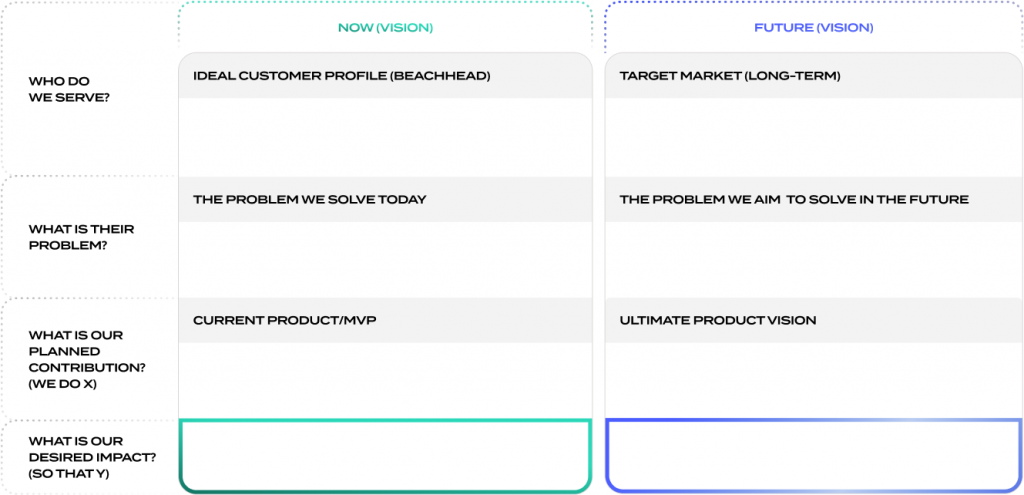
It’s deceptively simple, but it can take time to come up with the ideal Startup Id. Sometimes you need experimentation and iteration to find the elements that work. But fortunately, the questions you need to answer are straightforward. This means you can cycle through the Startup Id framework as often as you need until you get to an Id that works.
There are four simple questions to uncover your Startup Id:
- Why did you start the company?
- What is your secret? (the insight)
- Who do you serve?
- What is your desired impact and value proposition?
And just like that, you have the core building blocks. A simple 2×4 that helps articulate your near-term and ultimate purpose. Giving you and your startup team clarity and focus.
The sequence is deliberate. Each question builds on the ones that come before. However, as with so much in startup land, iteration can be helpful. So if you are stuck on some questions, feel free to skip ahead, answer what comes next and then loop back.
Although the questions are simple, answering them with clarity and conviction can take some thought and iteration. In the following, we’ll unpack each question with examples to bring them to life.
Mission and Vision
The Startup Id has two pillars. Near-term mission, and long-term vision. To be successful in business, we need clarity, focus and alignment. Visions are inspirational. They help align our founding team and early employees. And they are sometimes helpful for clarity. But they are not always so helpful for focus. As an example, think of Elon Musk’s vision to make humankind a multi-planetary species. To achieve this, there is an almost endless set of things we need to accomplish, e.g. in biology, medicine, agriculture, engineering, manufacturing etc. It is likely that no entity on Earth could successfully take all of this on at once.
So we break it down. We articulate a near-term mission. A proximate objective. In the case of Elon Musk and SpaceX, this might be reusable rocketry so we can dramatically lower the cost of bringing cargo into orbit. Once accomplished, we take on the next mission. Now we have focus and clarity.
Similarly for other startups. Visions help with alignment, but missions with focus. Define both, and you stand the best chance of building a successful company.
1. Why did you start the company?
Every business starts with an idea. Sometimes, a novel technical insight or solution gives rise to new opportunities. But for many of the best businesses, a gnarly problem provides founders with motivation and inspiration to build a company, so they can provide a solution.
Recounting your startup’s origin story is likely straightforward. But as you do so, there are two things, in particular, you are looking to tease out:
- The event or eureka moment that prompted you to start your business, and
- The specific insight (or secret) that sets you apart from your competitors.
The origin story is powerful because it helps you identify and articulate these two things.
If you are a group of founders, you can each take turns to recount your version of how your company came to be. As you try to crystallise answers to the two key questions above, it can be helpful to work with an outside mentor, adviser or investor. It’s sometimes easier to “see the forest from the trees” when you are one or two steps removed.
Inside the origin story is your personal “why”. The reason you started the company and your core motivation to build a business. This is often subtly different from the “purpose” of your startup. As an example, legendary founders Brian Chesky and Joe Gebbia started AirBnB because San Francisco is an expensive place to live, and they were struggling to make ends meet. They had a very personal connection to solving the problem.
That “why” lives inside the purpose of Airbnb. But today, AirBnB is about much more than expensive housing in San Francisco. It is powerful to have a “why” that connects you as founders to the wider purpose of your business.
2. What is your secret? (the Insight)
As you unpack your secret, here are four questions that might help:
- What is the opportunity you are addressing? What are you seeing that others are not?
- Why is this important? What trend is this leaning into that is unique and explosive?
- What do you believe about how to address/solve this opportunity that others don’t?
- How does this opportunity look in 10 years?
Connecting origin to insight
If you think back to your origin story, it likely reveals an insight that is at the foundation of your business. Maybe it is an insight about customers. As an example, before starting Airbnb, Chesky and Gebbia found out that people are willing to pay good money to sleep on a stranger’s airbed. Or maybe it is a key technical insight. Like Google, where Larry Page found that web pages could be ranked for relevance similar to the process used to rank academic papers.
Another word for insight is secret. In his book Zero to One, Peter Thiel discussed two types of secrets: secrets about people and secrets about nature.
He defines them in the following way:
- Secrets of nature: These are secrets waiting to be discovered. They can be found through deep research and exploration. They often involve fundamental scientific or technological breakthroughs.
- Secrets about people: These are secrets about how society functions or what people want but are not aware of. They are often insights into human behaviour or unmet needs.
Using Peter Thiel’s framework, Google is built on a secret of nature. And Airbnb is built on a secret about people.
Ask yourself, what secret have you uncovered that will help you build something people want? What do you believe that others don’t? What opportunity does this provide now, and in 10 years?
3. Who do you serve?
Perhaps the most important decision you ever make as a founder. Who do you serve. Here are four questions to help you hone the answer:
- Who do you sell to a decade from now?
- Which niche can help you fastest get to the first ten customers?
- What are their top problems? Which one can you solve?
- If this problem can be solved, how would customers measure their success?
Who is your customer now and in the future? And what problem can we help them solve?
Startup founders are ambitious. We want the whole world as customers. Or at least everyone in our target vertical. That ambition is great. It motivates the team and provides a long-term compass. But to win customers, we need to provide a solution that brilliantly solves their problems. And when we start out, we typically don’t have the resource to build solution that satisfies the whole world from day one. So we have to start with a niche. Our beachhead. The Ideal Customer Profile (ICP). Deciding on your target ICP is one of the most important decisions you make. It determines almost everything else.
How do you pick your ICP? Answer this question:
Who are the first 10 customers
whose problem I can solve better than anyone else
with the MVP I can build
for the money I have available (or can raise) today?
If your customers are very large (e.g. +$1m/year average contract value) then five might work. And if they are very small (e.g. $500/year), I might want more than 10 to validate my idea. But 10 is often a good starting point.
How would they measure success?
You validate the problem you are targeting by talking to customers. And when you think about your solution, you must make sure you solve a whole problem end-to-end. For example, if prospects are telling you that they’d like to automate process X to reduce costs, your solution needs to automate enough that they can reduce real costs. In that case, your customer might measure success through a reduced headcount. Or improved productivity in the department (e.g. the team is able to process twice as many transactions/revenue with no additional headcount).
4. What is your desired impact and value proposition?
As you work through step four, it is worth revisiting these questions:
- What does your ultimate product vision do?
- What long-term impact are you looking to deliver for your customers?
- What does your MVP do?
- What is your desired impact for the ICP of your MVP?
This helps you unpack both the long-term vision (what you are looking to deliver long-term) and the short-term mission (what you plan to deliver right now).
Determining your desired impact
Your purpose is to deliver positive impact for your customer. And you’ve figured out how they measure this (see above). And you need to work out how much impact you deliver, and how to distill this into a value proposition.
It is important to make sure that your solution solves the full end-to-end problem of the customer. If the solution automates bits of work, but the customer still needs the same headcount because a lot of the process is “outside scope”, you haven’t saved them any money. In that case, your ROI is negative.
Work with the customer to define a measurable impact and make sure you deliver on that. That’s how you get the land-and-expand flywheel going.
Pulling it all together
Once you’ve answered the questions, you can fill out the grid.
Here is an example from a well-known rocket company. No longer a startup, but one that’s been guided by a very clear mission and vision from day one.
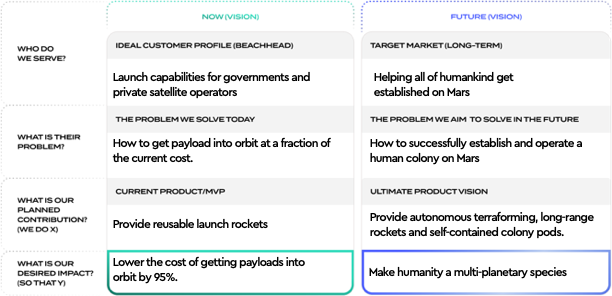
Now that you have your newly crafted Startup Id at your fingertips, you will similarly be able to achieve escape velocity and take a decisive step towards building a great company.
Frequently Asked Questions
What is a Startup Id?
It is the foundation of a startup's strategy, answering why the business exists by setting out who it serves, how it helps them and what impact it aims to create. It is laid out as a 2×4 grid covering a near-term mission and a long-term vision.
How should a startup choose its ideal customer profile?
Ask who the first 10 customers are whose problem you can solve better than anyone else with the MVP you can build for the money you have or can raise today. With very large contracts five may be enough; with very small ones you may need more than 10.
What is the difference between a startup's vision and its mission?
The vision is long-term and inspirational, helping align founders and early employees. The mission is a near-term, achievable objective that gives focus; once accomplished, the startup takes on the next mission.
Why does a startup's origin story matter?
It reveals the eureka moment that led to the company and the insight, or secret, that sets it apart. It also contains the founders' personal 'why', as with Airbnb's founders struggling with San Francisco's high cost of living.