




On 14 September, software shares rose about 5% and chip shares fell about 5%. Ryan Detrick, the chief market strategist at Carson Group, checked the record: going back 25 years, it was the best day software has ever had relative to semiconductors. For three years the AI trade ran in one direction. The money went to whoever sold the picks and shovels: the chips, the memory, the data centres. A day like that makes you ask whether something has turned.
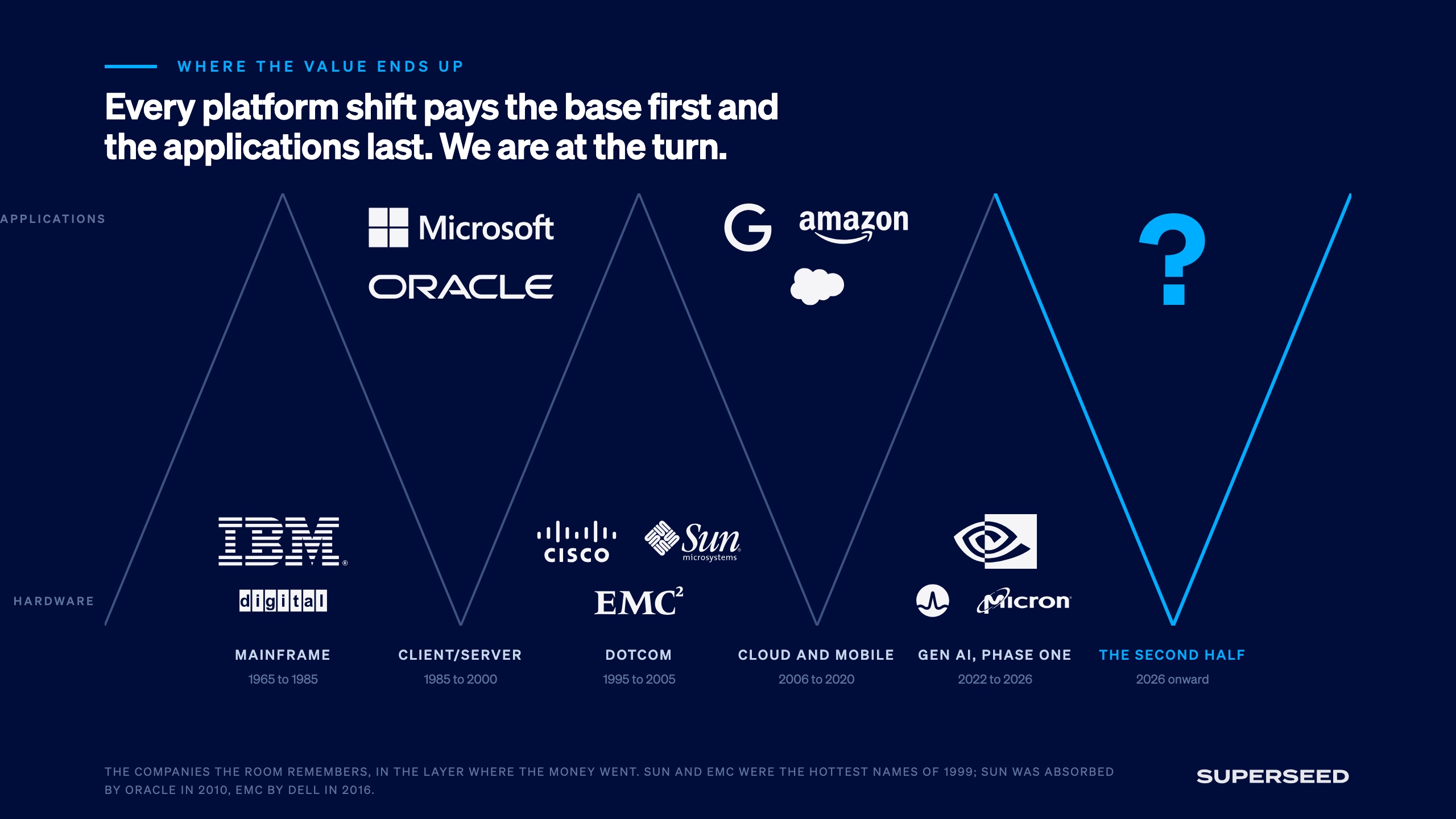
A year ago I wrote that value in AI would move from the infrastructure to the applications built on top of it. That has happened in every platform shift before. I also wrote that I could not tell you when: “The question is timing.” Twelve months on, I think the market has started to answer it. We are at half time. (I have written separately this month about how worried we should be about AI. This piece is about where the returns go next.)
The market has started timing it
Three signals point the same way.
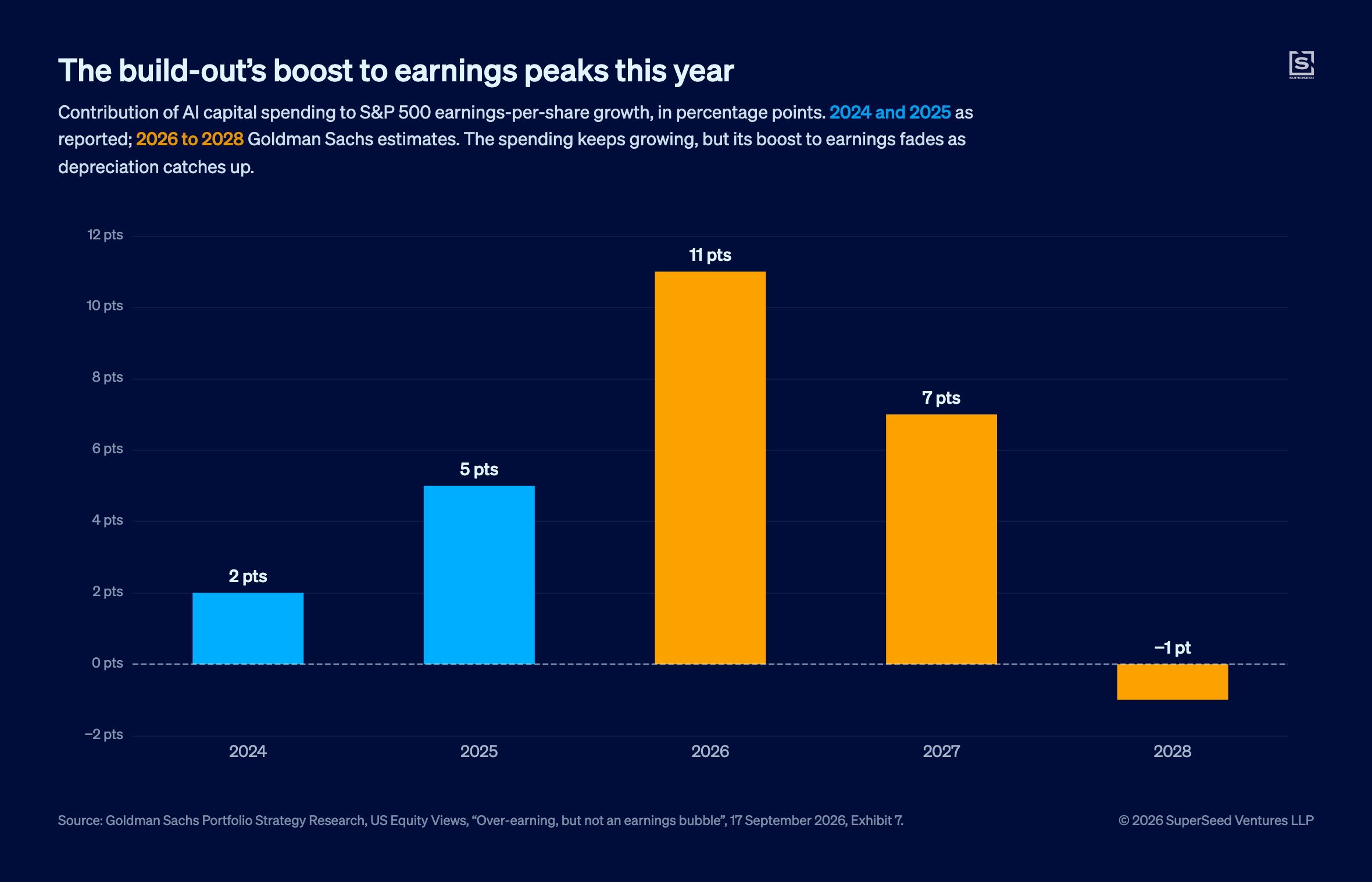
The first is in earnings. The build-out is still growing. The hyperscalers are expected to spend around $800 billion on capex this year, 94% more than last year. But Goldman Sachs estimates, in a note from 17 September, that the build-out’s boost to S&P 500 earnings growth peaks this year, at 11 percentage points. It falls to 7 points next year and turns negative in 2028, as depreciation catches up with the spending. How the build-out is paid for has changed too. In 2024, Alphabet’s capex took 42% of the cash its operations generated. In the first half of 2026 it took 95%. In those six months Alphabet borrowed $56 billion, sold $50 billion of new shares and bought back none of its own. Amazon’s capex now runs at 138% of its operating cash flow. That is what the late stage of a build-out looks like. The builders stop paying from the cash they earn, and start paying with debt and new shares.
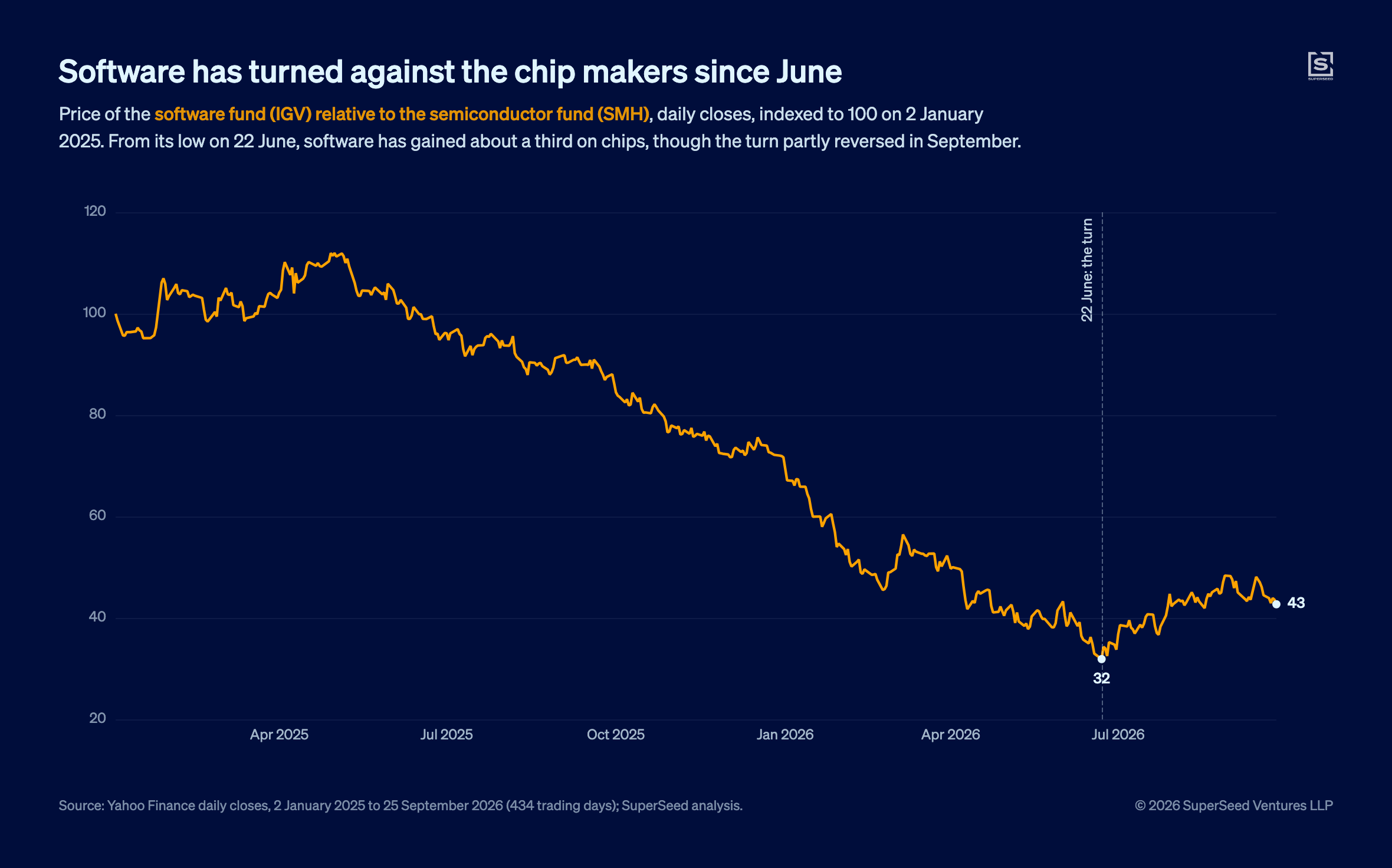
The second signal is in share prices. From 30 June to 25 September, the main software index fund (IGV) rose 17% and the main semiconductor fund (SMH) fell 7.5%. Salesforce rose 49%. The memory makers, the last and most cyclical leg of the chip trade, peaked in the last week of June. SK Hynix is down 30% since. It is early. Over the year as a whole, chips are still up 68% against flat software, and the turn partly reversed in September. Some of software’s rebound is also relief, after a spring spent fearing that AI would replace the software companies. But the direction changed in late June, and it has not gone back.
The third signal is in private capital, where the next generation of companies is financed. Dealroom counts $55 billion of venture money into robotics in the first seven months of 2026, and expects $89 billion for the year. That is almost three times 2025, which was itself a record. A handful of very large rounds, Waymo’s $16 billion among them, make up much of it, so the money is going into fewer, bigger companies. And the champion of the first half is buying into the layers above it. Nvidia agreed on 2 September to buy Hugging Face, the home of open-source AI models, for $12.9 billion. It has also backed 18 of the 38 start-ups founded since 2020 that are now worth $10 billion or more, more than any other investor.
What the market has not priced
So the first half is getting closer to its conclusion. What the market has not yet priced is the second half itself. On their second-quarter earnings calls, 65% of S&P 500 companies talked about AI. Only 2% could put a number on what it had done for their earnings, according to the same Goldman Sachs note.
Why is that gap so wide? The models are extraordinary. We run SuperSeed on them now. If the capability is there, why has the value not yet shown up in S&P 500 earnings?
It does not happen by itself
Because getting a new capability to work in production is most of the work. A demonstration shows what is possible. Production means handling every edge case, iterating until the thing holds, and redesigning the work around it. That takes longest where the know-how a business already has no longer applies.
Self-driving cars show how long it can take. In 2004 DARPA, the US defence research agency, ran a race for driverless cars across the desert. No car finished, and the best managed 7.5 miles. A year later, Stanford’s car won. The capability had arrived. Waymo opened the first fully driverless service to the public, in Phoenix, in October 2020. The 15 years in between went on edge cases. And a century of carmaking expertise did not carry over. Ford wrote off $2.7 billion when Argo AI closed in 2022, and GM shut down Cruise in 2024.
None of this is new. Factories took four decades to get the productivity gains of electricity, in large part because they first had to be rebuilt around the electric motor. Researchers call the ability to take in a new technology absorptive capacity, and it depends on how much related knowledge a business already holds. With AI the jump is so large that a lot of what businesses know no longer applies. We have to learn to be productive all over again.
Coding, the exception that proves it
There is one place where AI already pays its way at scale, and that is writing software. Coding and other computer and maths tasks made up 46% of the traffic on Anthropic’s API in November 2025. The reason matters.
Code comes with its own checker. Compilers, type checkers and automated tests say at once whether it works. That checker did two jobs. First, it let the labs train their models on code quickly, because every attempt could be graded automatically, over and over. DeepSeek’s R1 paper describes exactly this: a compiler runs the model’s code against test cases, and the result becomes the reward. Second, it let businesses put the models to work safely, because the code they wrote went through the same tests as a developer’s. The two fed each other. The models improved quickly at code, and code was where they were easiest to use.
A factory, a mine or a freight desk has neither. Nothing checks automatically whether a machine did the job right. So the models learn the physical world more slowly, and every deployment has to prove itself on site, safely, with people around it. Both halves of the work, teaching the models and putting them to work, are still to be done. That work is the second half.
Will it ever pay?
The obvious objection follows. If the work is this hard, perhaps it will not pay, or not for years, and now is the wrong time to invest.
I think three things answer it. First, AI finally works in the real world. It might have taken Waymo 15 years to get to autonomous taxis, but the company now gives more than 500,000 fully autonomous rides a week, twice as many as a year earlier. Second, the value of the work is rising, because much physical work is hard to staff. A food manufacturer that buys from one of our portfolio companies budgets for a quarter of its production-line staff to be absent on any given day. (Standing in what is effectively a big fridge, assembling salads in gloves, is not a job people queue for.) Third, an early-stage investor is not betting on today’s economics. A company we back this year reaches scale in five to seven years, on the costs and capabilities of the early 2030s. The difficulty also cuts both ways. It is what will protect the companies that solve it.
Who wins the second half
Incumbents will take some of it, and in-house teams will build some. New firms, though, have historically led where old know-how stops applying. Studying minicomputers, cement and airlines, Tushman and Anderson found that new firms introduced 7 of the 11 breakthroughs that made existing skills obsolete. Existing firms introduced 35 of the 37 that built on them. Waymo, a newcomer to cars, is the current example. The incumbents can see it. Komatsu chose the start-up Applied Intuition to build the autonomy for its next mining fleet, and this month Caterpillar announced a collaboration with FieldAI.
And if the market corrects first? Then the people who financed the chips and data centres, the shareholders and the lenders, lose money. The chips and data centres stay, and they get cheaper for the companies building on top of them. A correction decides who loses money on the first half. It does not stop the second half.
A year on
So has the turn begun? It looks like it. The market tells us we are roughly at half time, even if we don’t have the precise minute on the clock. The first half paid the companies that built the infrastructure, and the second half will pay the companies that make it do real work in real industries.
History also tells us when those companies get founded. SAP (1972), Microsoft (1975) and Oracle (1977) were founded in the mainframe era. Amazon (1994), Google (1998) and Salesforce (1999) were founded during the dot-com build-out. Airbnb (2008), Uber (2009) and WhatsApp (2009) arrived as cloud and mobile were built. The application giants of the AI era are being founded now.