





What does “AI” look like?
We were shown the answer as children. A machine that walks into a room, works out what is going on, and talks to you about it. C-3PO shuffles through the Star Wars films translating and fretting, and for a generation that image quietly did the work of a definition. Artificial intelligence was a metal person.
Then real AI arrived, and it was text.
Nobody’s childhood robot was a chat window.
But in the real world, thinking came first, disembodied, and it was the body that turned out to be the hard part. This is the wrong way round from every story we grew up on. I also think it explains a lot of what is going on right now with the money in robotics.
The most impressive robot demonstration of the year was also the most misleading.
In February, Unitree took the stage of the Chinese Spring Festival Gala (for the third year running). In front of one of the largest live audiences on Earth, its G1 and H2 humanoids did kung fu.
Its own account is worth quoting: the world’s first continuous freestyle table-vaulting parkour, the first launched aerial flip above three metres, the first continuous single-leg flips, a two-step wall-assisted backflip, and an Airflare grand spin of seven and a half rotations. Dozens of robots moving in formation at four metres a second. Wow.
Yes, it is extraordinary. And anybody who has watched engineers fight dynamic balance knows what a technical feat this is. Three years ago none of it existed.
Now read the list again.
Every world first on it is about motion. Balance, flips, spins, formation speed. Nothing about picking up an object the robot has not seen before, nothing about finishing a task nobody rehearsed, nothing about working beside a person who might move. Unitree published a triumphant account of its year, and every triumph in it belongs to the half of the problem that photographs well.
We built the graduate before the toddler.
In 1988, in Mind Children, the roboticist Hans Moravec wrote the sentence that has governed this field ever since: “it is comparatively easy to make computers exhibit adult-level performance in solving problems such as intelligence tests or playing checkers, and difficult or impossible to give them the skills of a one-year-old when it comes to perception or mobility.”
Large language models did not refute Moravec’s paradox. They are the largest confirmation of it ever run. We have machines that will argue Kant with you and machines that cannot reliably pick up a wine glass, and we got them in that order. Which is why the demonstrations keep improving, the money keeps going in, and the paid production work done by human-shaped machines stays close to nothing. Progress you can film and progress you can invoice have been drifting apart for three years.
Musk’s argument is better than his critics allow.
The world is already built for humans: doors, stairs, tools, cab heights, the position of a handle, all of it sized around our bodies. Build a machine with roughly our proportions and it inherits that installed base for free, with no cumbersome retrofit or integration work. Because it inherits everything, its market is not a task or a sector. It is work in the grandest sense. Elon Musk expects humanoids to outsell the global car industry by units, and ultimately, he might be right. If this works, everything else in robotics is a rounding error.
I was impressed by the vision of it. I still am.
But for the short term, I also think it’s wrong.
The body is a shim, and you pay for it twice.
A shim, in engineering, is the thin piece you push between two parts that do not quite fit. It bridges an incompatibility and does no work of its own. And in some ways, a humanoid robot is a shim between AI and a world built for people.
The first invoice is safety; Agility Robotics, the leading Western humanoid company, is going public this year through Churchill Capital at a $2.5bn pre-money valuation. Its filing contains the most honest sentence written about this industry all year:
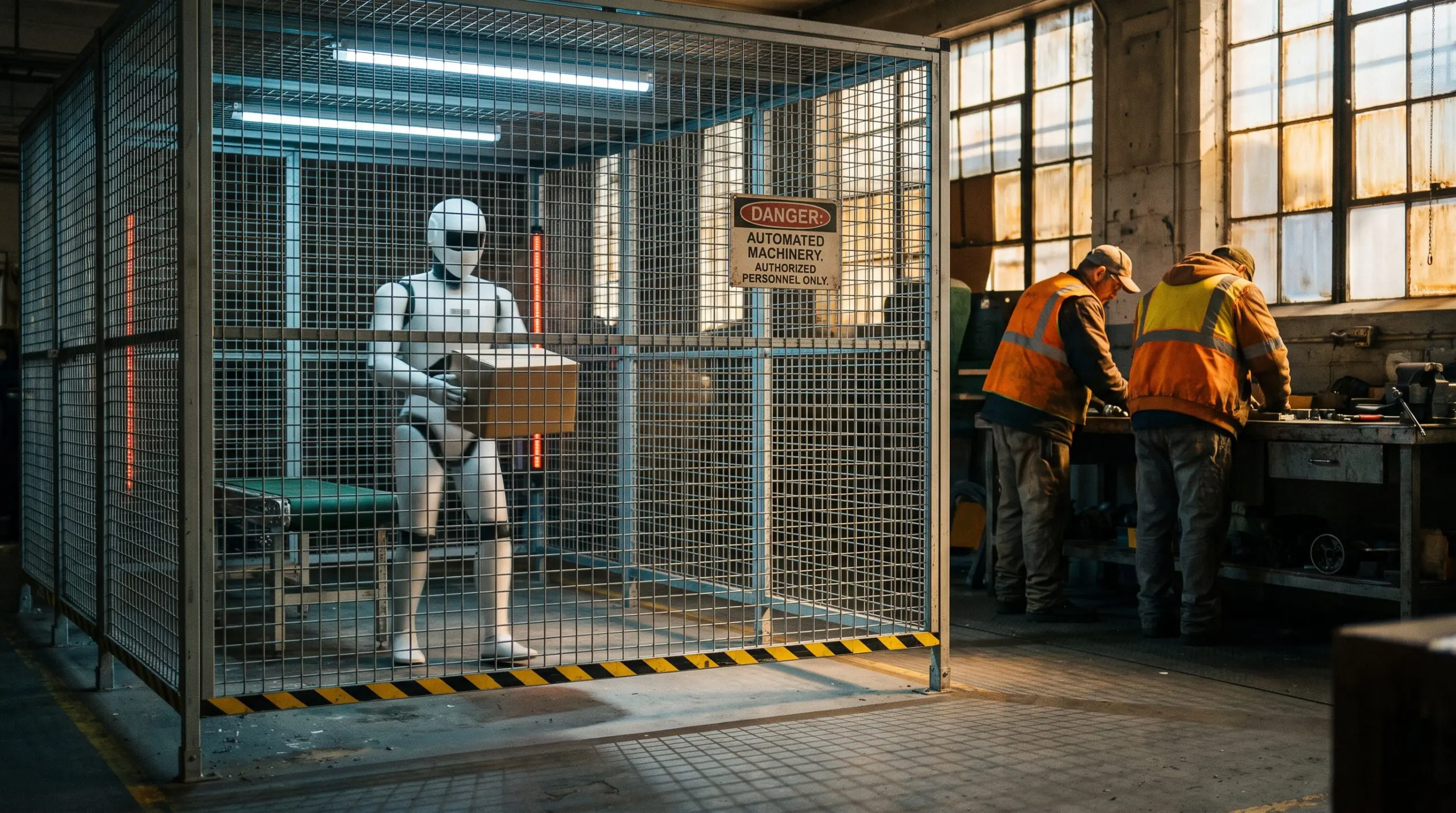
“Today, humanoid deployment requires robots and people to operate in segregated environments.”
Digit has logged more than 65,000 hours across nine customer sites. Real work, all of it done in rooms the people have been cleared out of. Agility’s answer is cooperative safety, which is a feature of Digit v5, which has not shipped. The company’s own paper on it is called “The Road To Cooperatively Safe Humanoids”. (note the preposition).
As my good man Dan Bowyer put it recently: you would not want one looking after your grandmother and falling on top of her.
Get a language model wrong and you delete the paragraph. Get sixty-odd kilos of actuator wrong next to a person and somebody goes to hospital.
98% of the way there is not nearly there.
It is a catastrophe with good averages. Which is why industrial robots have always arrived with cages, marked lanes and separated shifts. We made them safe by changing the room, and changing the room is cheap and paid for once.
There is also a second and less discussed invoice to be paid.
Human shape means human strength. Agility publishes Digit’s carrying capacity at 35 pounds. 35 pounds is hand luggage. And this is not nearly enough in many of the places where we want to automate things. On a building site, the things that need moving start north of 100 kilos. Humanoids don’t come close to lifting that. Every argument about humanoids assumes the constraint is intelligence, and that a better model unlocks the market. Almost nobody asks why you would buy a machine that tops out at what a person can carry, for the jobs whose whole point is to exceed what a person can carry.
Granny is the target market, not the edge case.
Which points somewhere more useful than “humanoids are early”.
Split the world into habitats and non-habitats.
Habitats are the places we keep at human scale because we live in them: homes, streets, the inside of a shop. Non-habitats are shaped by production rather than by people: factories, warehouses, freight yards, building sites. A freight yard has no sentimental attachment to being walkable.
The humanoid’s one real advantage is compatibility with a world that has to stay human-shaped. In a habitat, that is worth paying for. In a non-habitat it is worth nothing, because you can move the walls.
So look at where the industry is pointing.
Warehouses, factories, logistics, every one of them a non-habitat, where the form factor’s only advantage does not apply and both of its bills arrive in full. The one environment where a humanoid genuinely is the right machine is the family home, which carries the highest safety bar of anywhere on the list and the longest timeline by a decade. Dan’s grandmother is not a joke about an edge case. She is the target market, and she is the hardest customer in the world.
Put the brain in the forklift.
None of which makes me bearish on robotics. It makes me bullish on a different kind of robot.
Physical AI is the wide category and the thesis we have backed for years, intelligence moving into machines and physical operations. Embodied AI is one component inside it, and humanoids are one form factor inside that. Doubting the third is not doubting the first.
Customers, in my experience, have no view on form factor whatsoever. They have a problem and a budget. A great deal of industrial work is moving things from one place to another, and if I want my forklift to drive itself, I am not going to buy a mechanical man to sit in the seat and turn the wheel. I am just going to put the brain directly into the forklift.

And this is roughly what the companies taking orders are doing. In June a Barcelona company called THEKER raised $85m, led by CRV with Samsung and LVMH joining existing backers including Inditex and Mercadona. It builds generalist factory robots that get retrained across tasks rather than reprogrammed for each one, and the company says they are already working inside live Inditex production facilities. Two of its customers sit on its cap table, which tells you more than the round size does.
Tesla is running both bets, and only one of them has been proved possible.
Tesla is making this argument both ways at once. Cybercab entered production this quarter, described in the filing as “our purpose-built autonomous EV designed to be the workhorse of our Robotaxi fleet”.
Purpose-built: they took the human shim out of the car, exactly as the autonomy teams took out the steering wheel. Optimus is the other bet, and the Fremont line is still going in. The filing notes that the first units off it “will be used in our Optimus Academy for training data collection and further functionality development”. An academy. For the robots. Before a single customer takes delivery.
At this point, neither is proven. But somebody else has already proven the robotaxi: Waymo has driven more than 200 million rider-only miles, which settles whether a car can drive itself for money. This leaves Tesla with an execution problem, and execution is what Tesla is for.
Which is why I am not bearish on Tesla. Robotaxi is the more interesting half of the company, and my guess is that Tesla finds something useful for Optimus inside its own factories while the technology matures enough to be ready for our homes.
Why the money keeps arriving anyway
Everybody in venture can do this arithmetic, so why is the capital going the other way?
Partly C-3PO. Humanoids have been our picture of artificial intelligence for fifty years and they photograph beautifully. Put one on a stage and it leads the evening news. “We put the intelligence into the forklift” is less evocative, however good the business underneath it.
So, are we at the Newton or the iPhone moment for humanoid robots?
My bet is that humanoid robots will not ship at commercial scale this year, and they will not next year either. Beyond that I have instinct rather than analysis, and I would rather label it than dress it up. I find it hard to picture one in my house inside five years, and I say that as a lifelong science fiction obsessive who spends most of his working day with AI. The person most primed to want one is telling you it does not feel close.
One last thing about C-3PO. He is a protocol droid. His job in those films is language: translation, etiquette, six million forms of communication. So we did build him. We built the part of him that talks, we built it first, and we built it at a speed that startled the people building it, because talking turned out to be the easy part.
The kung fu, it turns out, was the easy part too. Everything that is actually hard, and everything that will actually be worth owning, sits in the gap between a robot that can spin seven and a half times in the air and one you would trust alone with your grandmother.