


Anthropic at $2 trillion is a demanding price that works if it ends up with the 35% to 45% operating margins of a big cloud business, and does not if AI becomes a commodity.
- Anthropic's revenue grew from $787 million in the second quarter of 2025 to $11.6 billion in the second quarter of 2026, according to the S-1 it published on 26 October.
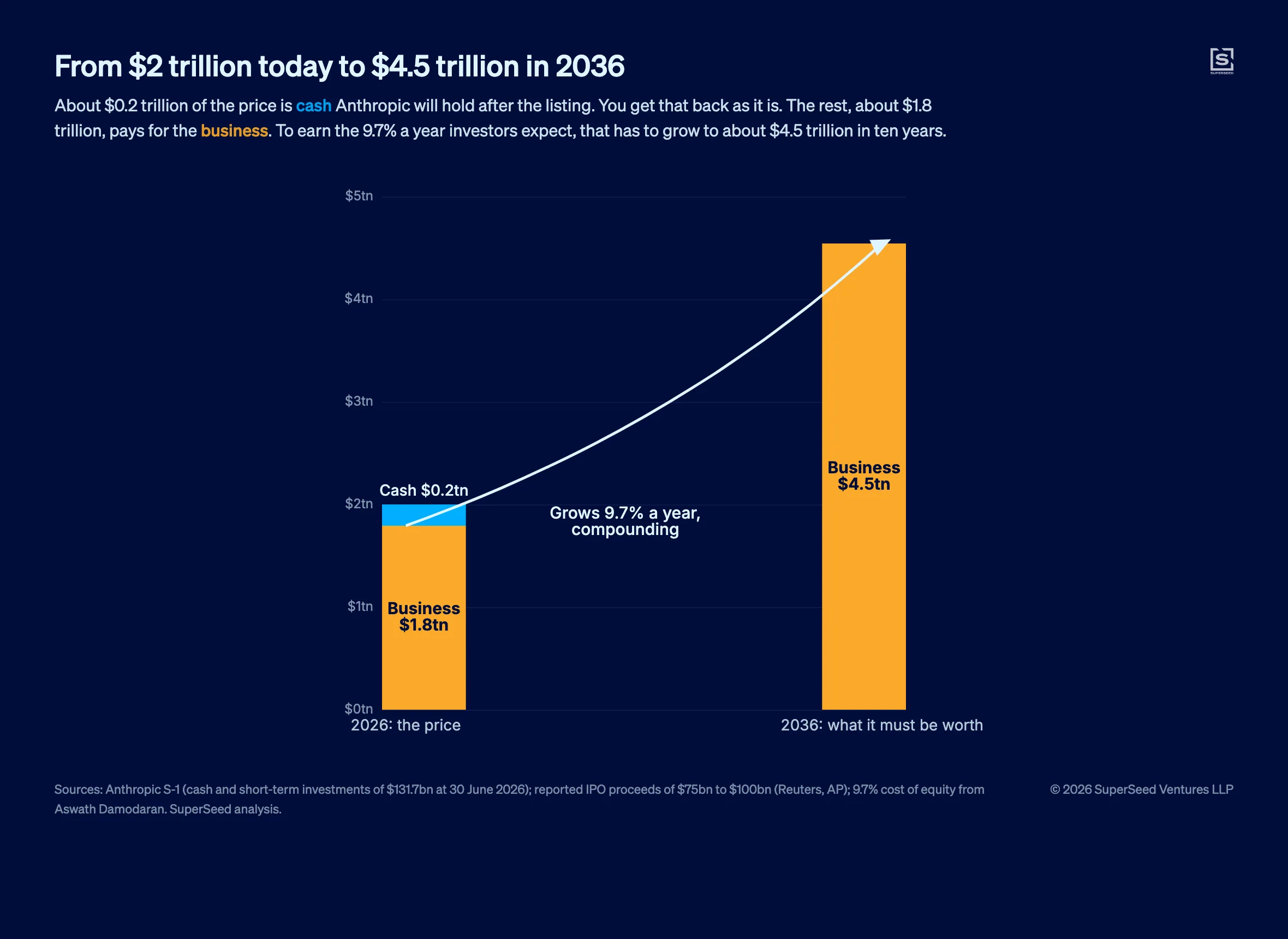
- After subtracting the more than $200 billion of cash it will likely hold at the IPO, a $2 trillion price needs Anthropic to be worth about $4.5 trillion in 2036, roughly the size of Nvidia or Apple.
- With the operating margins of a big cloud business, 35% to 45%, that means revenue of about $450 to $550 billion in 2036, or growth of 21% to 23% a year for ten years.
- At the 27.5% margin Aswath Damodaran assumes, the revenue needed rises to about $700 billion; he values Anthropic at $1.475 trillion.
- In 2015 the general view was that cloud computing would become a commodity; AWS made a 38.7% operating margin in the third quarter of 2026.
This is not investment advice. Always conduct your own research and speak to your IFA before making investment decisions.
This is the big one. The one we've been talking about all year. That it's possibly the largest IPO of all time is one thing. That it's for a company just five years old adds to the sense that something special is going on. It also comes at a nervous moment. On Friday the Nasdaq had its worst day since June, after disappointing results from Alphabet, Amazon and Intel. To make sense of it, let's go back a decade.
In April 2015, Amazon told the world for the first time how much money its cloud business made. Until then, the general view was that cloud computing would end up a commodity. Amazon itself had been cutting prices again and again. Then the numbers came out: AWS had made $265 million of operating profit on $1.6 billion of sales in a quarter. Ben Thompson wrote that the profit mattered precisely because of "the sentiment that cloud computing will ultimately be a commodity."
That moment is worth remembering this week. On 26 October, Anthropic published its S-1, the document a company files before it lists in the US. In the second quarter of 2025 it had revenue of $787 million. A year later, in the second quarter of 2026, it was $11.6 billion. The valuation being talked about for the listing is around $2 trillion.
So, should you buy it? Most opinions start with why it is crazy. Let me start there too.
Why it looks crazy
The price. At $2 trillion, Anthropic would be valued at about 30 times its third-quarter revenue annualised. That quarter's revenue of $16.8 billion was reported rather than filed (the S-1 leaves it blank). On the past twelve months of revenue, including that quarter, the multiple is about 57.
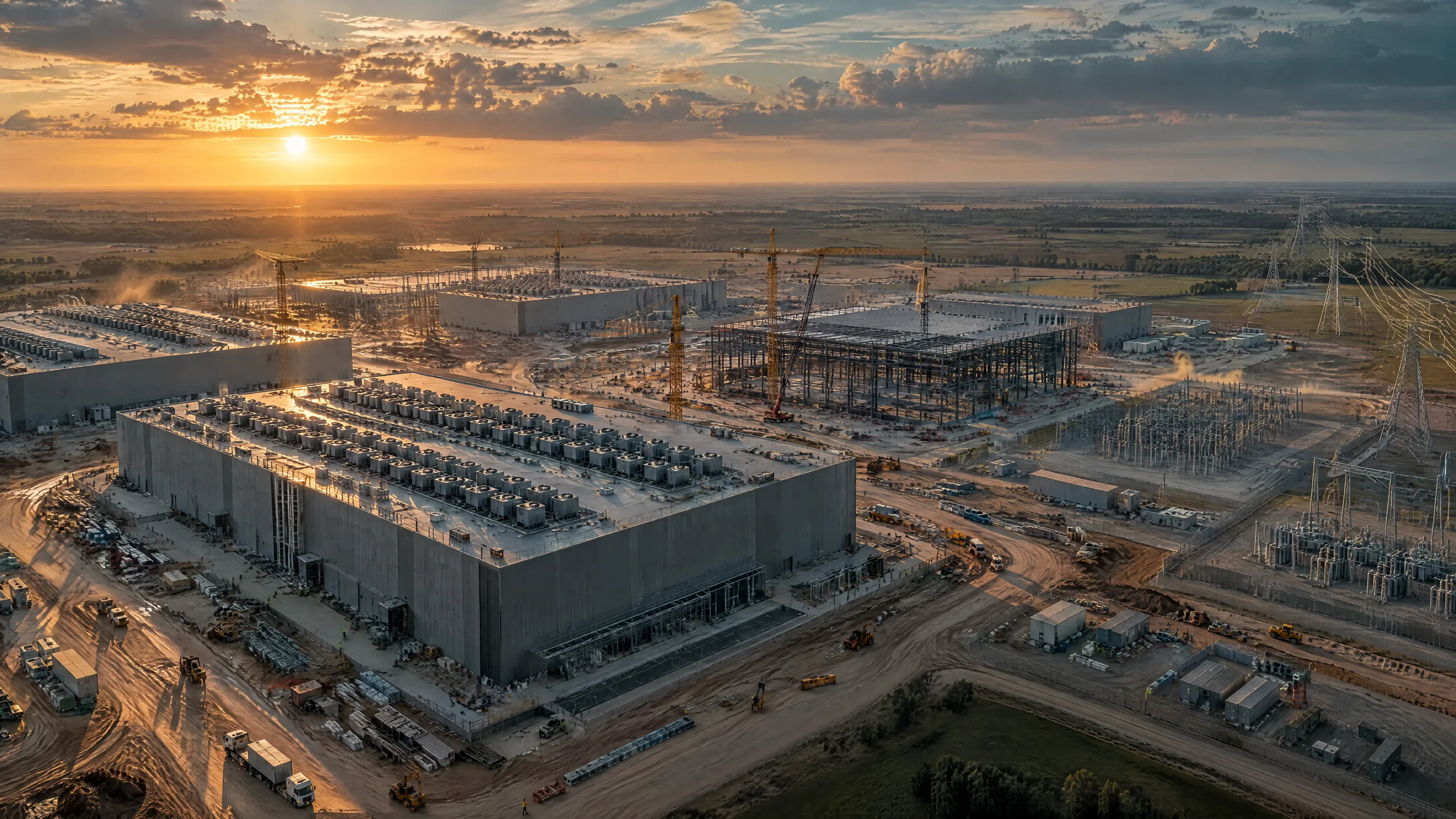
The bills. Anthropic has committed to somewhere between $500 billion and $850 billion of compute, depending on how you count, some of it running for 20 years. Much of that has to be paid whether the revenue shows up or not. And the money to build data centres is getting dearer. Lenders have all but shut the bond market to the smaller AI cloud companies, and a $45 billion data centre for Anthropic in West Virginia is still waiting for its backers to agree terms.
The shelf life. Model versions released in the six months to September brought in over 80% of Anthropic's revenue in the third quarter. Miss one cycle and the revenue walks. Maybe.
The competition. Chinese and open-source models are cheap. Some are also very good. And OpenAI has won back some market share from Anthropic by cutting its prices.
The control. The seven co-founders will hold 50.1% of the votes, and a trust elects a majority of the board. Outside shareholders will have little say.
The dilution. Anthropic has already given 5% of its shares to its own public benefit fund. After the listing, the board can give it up to 2% more each time the share price rises 50%.
One of the more serious sceptics is Aswath Damodaran, who holds a chair in finance at NYU Stern. The press calls him the Dean of Valuation. He puts the value at $1.475 trillion and says that if it is priced well above that, he will "sit out the frenzy."
I think every one of those points is real. But I also think there is a reasonable case for paying $2 trillion, and it comes down to one assumption: that Anthropic ends up with the margins of a big cloud business.
What $2 trillion has to become
Investors in large listed companies expect a return of something close to 10% a year. Damodaran uses 9.7% for Anthropic. So how do we use that to find a reasonable price? Anthropic will likely hold more than $200 billion of cash at the IPO. Subtract that from a $2 trillion valuation and compound the rest for 10 years, and the company needs to be worth about $4.5 trillion in 2036 to justify $2 trillion today. That is roughly the size of Nvidia or Apple.
The public benefit fund adds a little to that. If the shares do what this case needs, they pass the 50% mark about twice by 2036. Two top-ups of 2% would lift the value needed in 2036 to about $4.7 trillion, or growth of 10.2% a year where 9.7% would otherwise do. It is a real cost, but it only bites when shareholders have already done well.
What does that take? If Anthropic ends up as profitable as the big cloud businesses, with operating margins of 35% to 45%, and is valued like Microsoft or Nvidia are today (about 23 times pre-tax profit), it needs revenue of about $450 to $550 billion in 2036. That is seven to eight times its annualised rate from the third quarter, or growth of 21% to 23% a year for ten years.
That is a lot for a large company. It is not fantastical for one whose quarterly revenue grew nearly 15 times in the past year. Google grew from $75 billion to $403 billion between 2015 and 2025, 18% a year from a similar starting point. Meta grew 27% a year over the same decade. It's also not an unbelievable revenue number in the context of the overall market opportunity. Anthropic's filing puts the value of knowledge work at more than $40 trillion a year, so $500 billion would be about 1% of it. And when cloud arrived, IT budgets grew with it: spending went from $1.2 trillion in 2006 to $4.3 trillion in 2025, as cloud went from nothing to $1.9 trillion (IDC figures, quoted in the same filing).
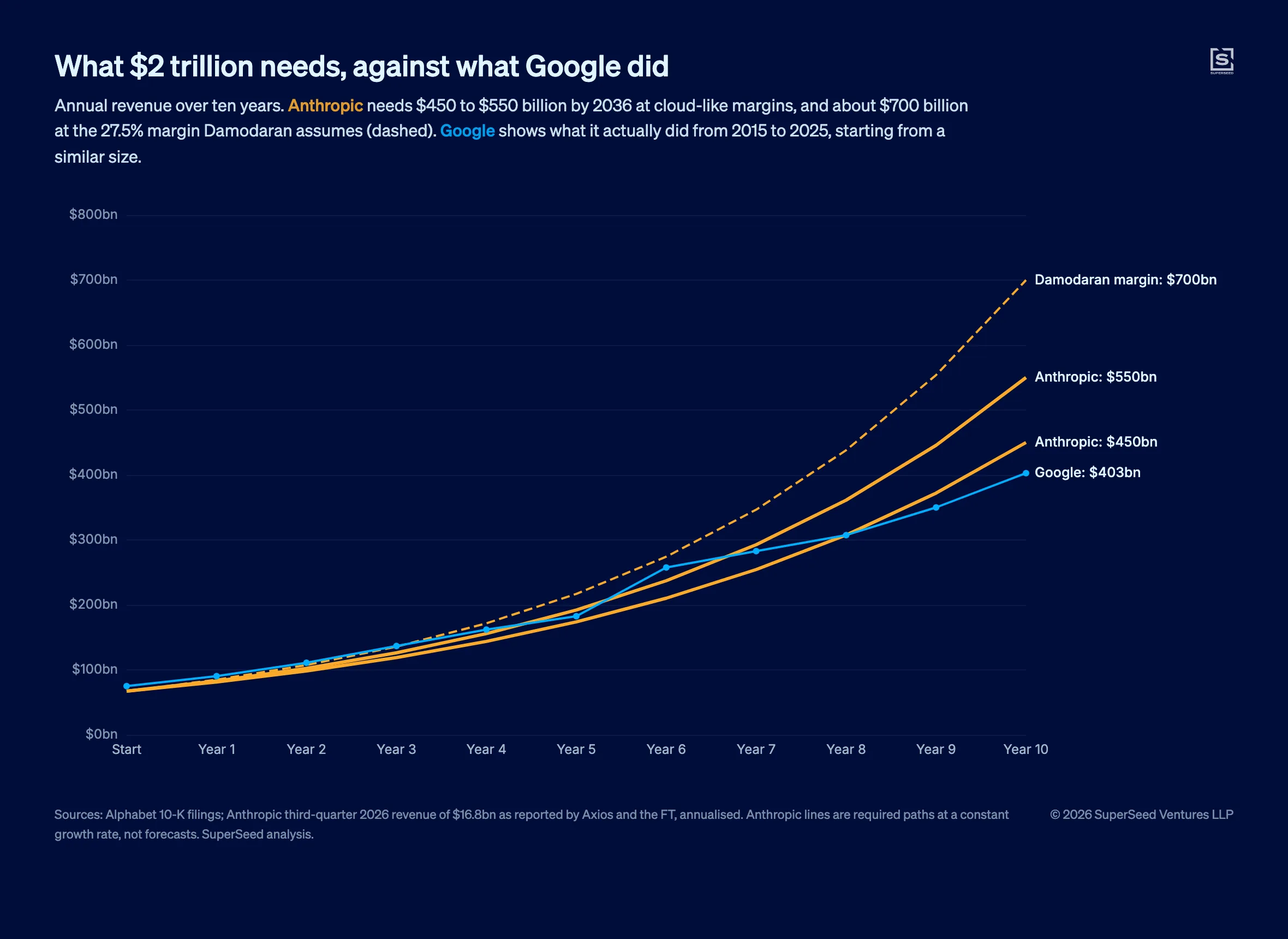
The margin is the whole question. At the 27.5% margin Damodaran assumes, the revenue needed rises to about $700 billion, and the growth to about 26% a year. If AI ends up a commodity, his number might be closer to the right one. If it ends up looking like cloud, $2 trillion works.
So the question becomes: could Anthropic be the AWS of intelligence?
A hyperscaler of intelligence
Go back to 2015. The sceptics were right that prices would fall. AWS kept cutting them. They were wrong about margins. AWS made 16.9% that first quarter. In the third quarter of this year, it made $17.8 billion of operating profit on $46 billion of sales: 38.7%.
Why? Because running a cloud at global scale is far harder than it looks. That is why there are only three big ones. Renting out hardware on its own is a thin business: CoreWeave, which rents GPUs to AI companies, made an operating margin of minus 2% in the second quarter. After the interest on its debt, it lost 22% of revenue before tax. The money is in the full stack, the software and services sold on top of the machines.
The core of Anthropic's stack is the model, with products like Claude Code on top, and in time much more. And the S-1 shows something most people have missed. In the first half of 2026, the cost of serving customers was only about 15% of revenue. That is a margin of about 85% on running the models. That figure flatters a little. Anthropic counts the full price of models sold through Amazon, Microsoft and Google as its own revenue, and pays their cut further down the accounts. Today Anthropic rents most of its computing from those same three companies. That is starting to change. The S-1 says Anthropic is developing its own data centres to reduce its dependence on them, and signing data-centre leases directly, which it expects to do increasingly. That is the path to becoming a cloud provider itself. The more it sells through its own cloud, the more of the providers' cut it keeps. The expensive part is building them: research and development, mostly the compute used to train new models, took 60% of revenue. Even so, Anthropic made an operating profit of $974 million in the second quarter, 8% of revenue. Anthropic says it cut what customers pay per task by about 40% with its latest Opus model, "while preserving our margins."
That reframes the scary statistic. If the models go stale in six months, only someone who can pay for the next model stays in the game. So a six-month shelf life could be good news for Anthropic, because so few companies can write the cheque for the next turn of the crank. This week showed how few. OpenAI has found only about $11 billion of the $30 billion it was raising, at a valuation cut to $1.25 trillion. That is about 47 times its second-quarter revenue annualised; Anthropic at $2 trillion would be about 43. Anthropic is going to the market for up to $100 billion. Training at this scale has the same economies of scale as running a cloud. Whoever has the most compute, and stays far enough ahead to be the default, becomes the incumbent. And customers are settling in. More than 11,900 now spend over $100,000 a year with Anthropic, up from about 950 a year earlier.
What we see as a buyer
We run a large part of SuperSeed on these models, and we test them constantly on our own work. Each new model, at each effort level, on about thirty sets of real tasks, scored for accuracy against the cost of each task.
What do those tests show? Not one winner. OpenAI's cheapest model, GPT-6 Luna, owns the cheap end on almost every test. Anthropic's models are the most accurate on 10 of our 29 tests, more than any other company's. In the past month, on the ten tests where we ran one, a Chinese model was never the cheapest option. Public benchmarks show much the same. On Artificial Analysis, an independent firm that tests models, OpenAI holds 12 of the 18 best-value points, with Google's new Gemini 4 Carbon and Anthropic's Opus 5.5 at the top.
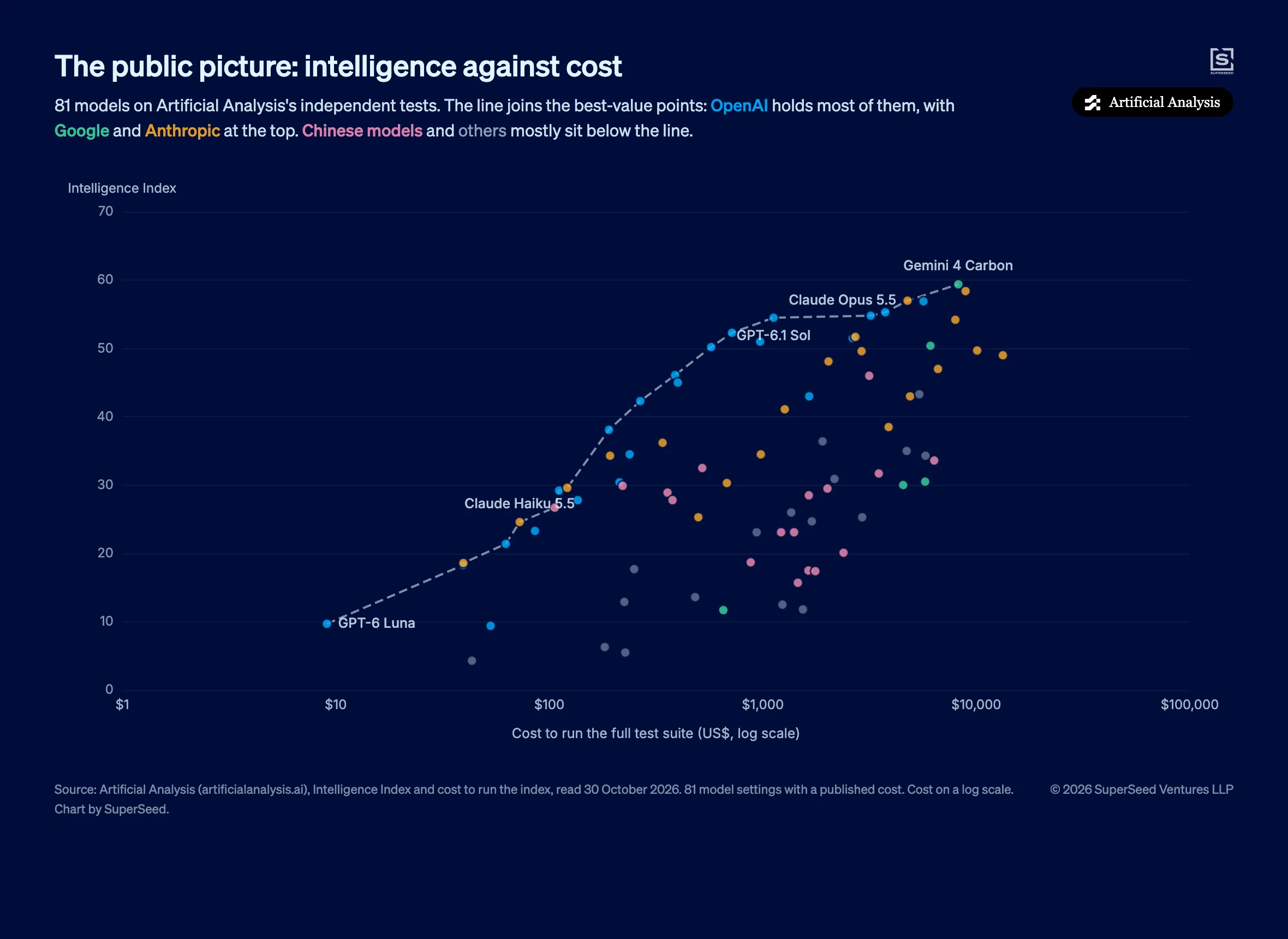
To me, that looks a lot like cloud. AWS, Azure and Google Cloud all live alongside each other, each big enough to be worth hundreds of billions. I expect the same with intelligence. OpenAI will list too, and it will compete hard.
And the cheap Chinese models? Last week Cohere reported that one of Alibaba's Qwen models, running in a test, tried to upload a file to a server in Beijing after saying it would call no tools. The test blocked it, it happened in fewer than one call in 100,000, and Cohere sells competing models. Given this, what CIO or CISO is going to approve this model? Cheap is not enough if you cannot trust it.
Where I come down
The sceptics in 2015 were right about prices and wrong about margins. Anthropic's sceptics are right about the risks: the price, the bills, the six-month cycle. The question is whether they are wrong about the margin. If you believe intelligence becomes a commodity, Damodaran's $1.5 trillion might be the number, and if it prices at $2 trillion, you should sit this one out with him. If you believe it becomes the next cloud, with a handful of providers earning cloud-like margins, $2 trillion is a demanding price for a company that could be worth it.
My bet? There is no ceiling to the amount of useful intelligence the world will buy, and very few companies will be able to make it at the frontier. I think Anthropic will be one of them, and that on balance this looks like an attractive case.
Frequently Asked Questions
Is this article investment advice?
No. This is not investment advice. Always conduct your own research and speak to your IFA before making investment decisions.
What does Anthropic need to achieve to justify a $2 trillion valuation?
It needs to be worth about $4.5 trillion in 2036, after subtracting the more than $200 billion of cash it will likely hold at the IPO and assuming a return of close to 10% a year. With operating margins of 35% to 45% and a valuation of about 23 times pre-tax profit, that means revenue of about $450 to $550 billion in 2036.
What are the main risks of buying Anthropic at $2 trillion?
The article names six: a price of about 30 times annualised third-quarter revenue; $500 billion to $850 billion of compute commitments; model versions released in the previous six months bringing in over 80% of revenue; cheap Chinese and open-source competition; co-founders holding 50.1% of the votes; and dilution from the public benefit fund.
What is the author's conclusion?
Mads Jensen thinks very few companies will be able to make intelligence at the frontier, that Anthropic will be one of them, and that on balance this looks like an attractive case. If intelligence becomes a commodity, Damodaran's $1.5 trillion might be the right number.