




Earlier this year we built ourselves a software factory. Autonomous pipelines that write code, check it, test it and push it to production, with almost nobody in the loop. It worked. Then it stopped working in the most glorious way. The checking stages found problems faster than the building stages could clear them, every fix triggering a fresh review, which triggered the factory to build more code, until it fanned out into hundreds of open issues all competing with each other. We had built something superb at finding work and something that just couldn’t quite finish it.
Nothing was wrong with the AI models. They did precisely what we asked. What was missing was the experience of what happens when you point them at a live system at full speed. There is no good way to acquire that except by running it and watching it break.
Andrej Karpathy, who helped found OpenAI and later ran artificial intelligence at Tesla, wrote in December that he does not think the industry has realised anywhere near ten per cent of the potential of these models even at their present capability. Not the next generation. I think he is right. And I think a seized-up software pipeline is what his ten per cent looks like from the inside.
Four announcements in nine weeks
Something odd happened between the fourth of May and the second of July.
Anthropic set up an enterprise AI services company with Blackstone, Hellman & Friedman and Goldman Sachs. OpenAI created a majority-owned AI services company with more than four billion dollars of initial investment behind it. AWS committed a billion dollars to embedding their own AI services engineers inside customer teams. Microsoft committed two and a half billion and six thousand people to the same idea, and went out of its way to say the effort goes beyond what the industry has been calling forward deployed engineering.
Then on the thirteenth of August, Anthropic advertised for its first forward deployed engineering manager, in London. The advert says so itself: “As the first FDE Manager, you’ll own the team that sits at the frontier of enterprise AI deployment.”
Four of the most capable and best capitalised companies on earth, each selling a product that is so smart it’s practically supposed to implement itself, deciding at the same moment that they need their own people sitting in their customers’ offices.
That is a tell.
What it tells you
For thirty years, venture investors knew what good looked like. Intellectual property heavy, people light. Services were low margin and awkward to scale, and the best technology was whatever you could package with the least labour wrapped around it. I have sat in plenty of rooms where “it’s a services business” ended the conversation.
So when the frontier labs all move the other way at once, the interesting thing is what they can see that the rest of the industry has been slower to admit.
What they can see is that the constraint has moved off the model and onto everything around it.
Two economists described the mechanism in 1990, long before any of this. Wesley Cohen and Daniel Levinthal called it absorptive capacity: a firm’s ability to recognise the value of new external information, assimilate it and apply it commercially, an ability built out of everything the firm has already taken up. Their warning was aimed at fast-moving fields. A firm that stops investing in that capacity, they wrote, “may never assimilate and exploit new information in that field, regardless of the value of that information.”
So when you have fallen behind, or when the field is moving too quickly for you to keep up internally, you can rent somebody else’s expertise. And that is the business all four of them entered this year.
The work is large because the AI revolution has unleashed unbelievable capabilities at break-neck speed, creating a big gap between what we could potentially do and what we actually know how to do. And so, we are at a stage where everybody is figuring out how to create value with AI by trying it, watching it fail in a way nobody predicted, and carrying that into the next attempt. Which is our pipeline, and Karpathy’s ten per cent, and the reason four companies with paradigm-shifting technology have just set up their own consultancy businesses.
Two companies already living there
Palantir has been doing this for twenty years and its filings are unembarrassed about it: “We embed directly with customers across numerous industries, tackling complex challenges while continuously enhancing our platforms’ capabilities.” Being in the room is how the product gets good. In the second quarter its revenue grew 93 per cent year on year to 1.9 billion dollars, while its headcount fell from 4,429 to 4,401 over the preceding six months, at a gross margin of 84.7 per cent. It seems Palantir has figured out how to scale a services business without growing headcount. That’s how you get to be valued at a Price/Earnings ratio of >150.
Mistral is arriving at the same destination from the other direction. It set out to compete at the AI frontier, and it has been quietly repositioning ever since into something closer to Europe’s enterprise AI implementation champion. It still trains its own models, and says it still has a frontier model in training. But the flagship it shipped in December has an architecture that resembles DeepSeek V3’s almost parameter for parameter, down to the rank of the projections inside the attention block. Its own engineers describe the design as heavily inspired by DeepSeek while denying the model was built on top of it. Neither the launch post nor the model card mentions DeepSeek anywhere.
Then in August it began selling inference on Z.ai’s GLM-5.2, a Chinese open model, in its own documentation’s words “served without Mistral modifications”. Its chief technology officer explained that without a flicker of embarrassment. “It’s a great model. Everyone loves it. It’s open weight, so there was no good reason for us not to do it, really.”
If the real value sits in making models work properly inside an enterprise rather than in building the next frontier model, why not? Sovereignty purists will hate all of it. I think they are watching the wrong layer.
But is there anything new in having IT consultants deploy tech?
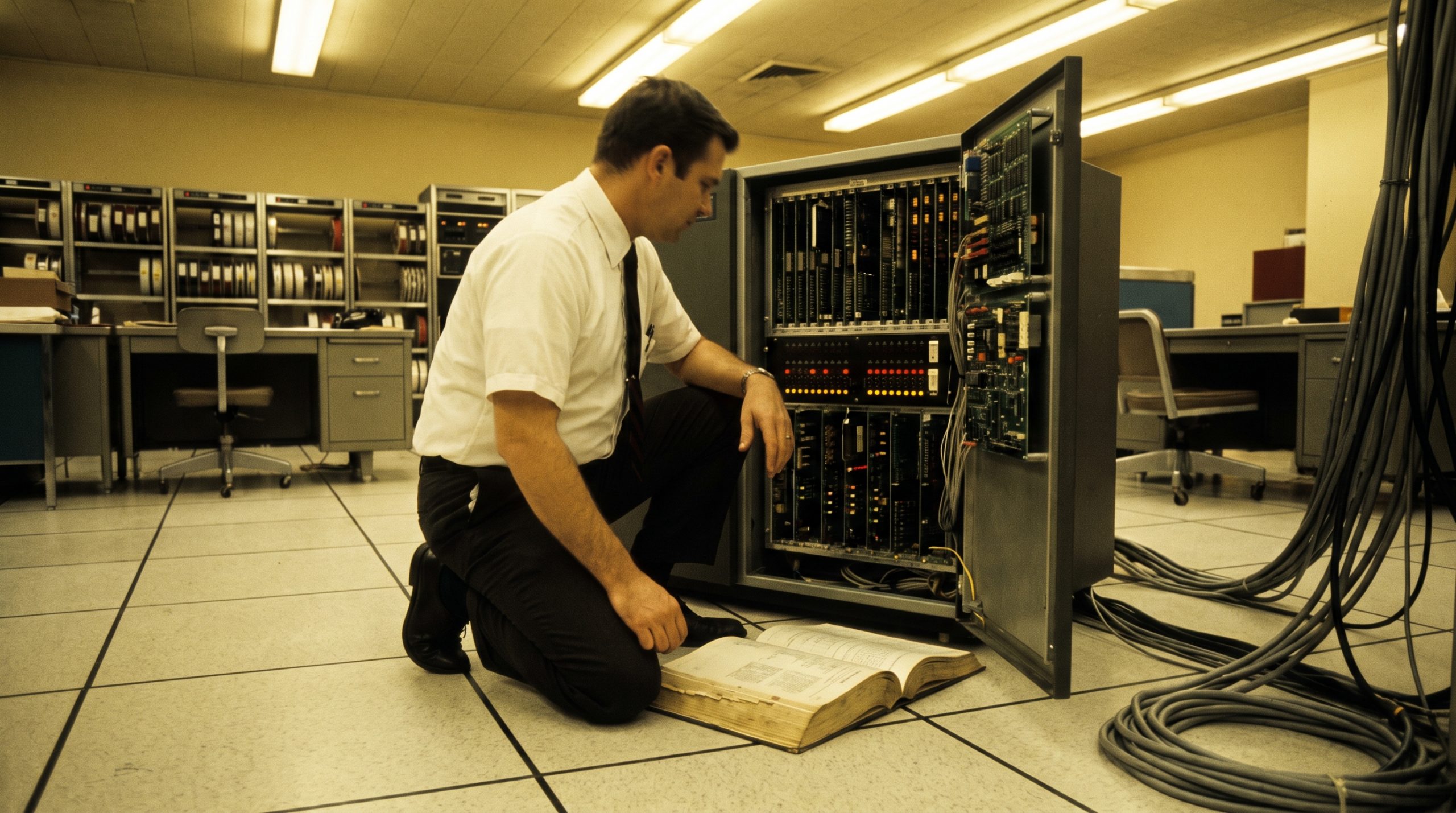
In some ways, there is nothing new under the sun with the Forward Deployed Engineers. IBM sent engineers out to install the mainframe in the 1960s and 1970s because nobody else could. Packaged software then standardised enough of the problem that engineers gave way to consultants who configured, and implementing SAP is scripting and configuration. An industry worth hundreds of billions grew up doing exactly that.
On that reading, what happened between May and July is the pendulum swinging back, and only because the technology is three and a half years old. Give it time. The tooling matures, the patterns harden, the work turns into configuration again, and today’s deployment arms settle into a normal mid-margin business.
I think that is right. It also does not tell you what to do now.
The word carrying that whole argument is “eventually”. Configuration takes over when the pace of technology change slows down, and AI is still accelerating. Every few months these models do something they could not do before, and each jump opens work nobody had thought to scope, inside companies that had only just finished absorbing the last one. The world cannot take up capability at the rate it is being produced. So services matter a lot, right now.
Who ends up with the understanding
If the frontier labs have concluded that realising the value is just as hard as producing the capability, that tells you where to look. It points at whoever understands one industry deeply and this technology deeply, at the same time.
It’s no longer possible to win by just having good models. You win by understanding the operation and the technology at once, so you can provide customers with an end-to-end solution that actually works. You don’t wrap services around your technology because you are trying to become a consultancy. You do it to sell a working result, and getting the customer there is part of what you are selling.
You can buy that result. A consultancy will come in, build the thing and leave you with something that works. What you cannot buy is the capability to repeat that yourself, because it stays with whoever did the work. That is Cohen and Levinthal’s real point. The ability to take up the next new thing is built out of everything you took up before, so if somebody else did the absorbing, they got the capability and you got the deliverable.
Which is exactly why the frontier labs are doing this themselves rather than leaving it to the integrators. They are not being generous. Every deployment teaches them something about their own technology that no amount of internal testing would surface, and that learning compounds in them.
A tenth of what these models can already do is in use. The other nine tenths is waiting for somebody to sit inside a business and work out what it means there, and to find that out the way we found out about our pipeline, by running it until it breaks. The understanding goes to whoever does that.