


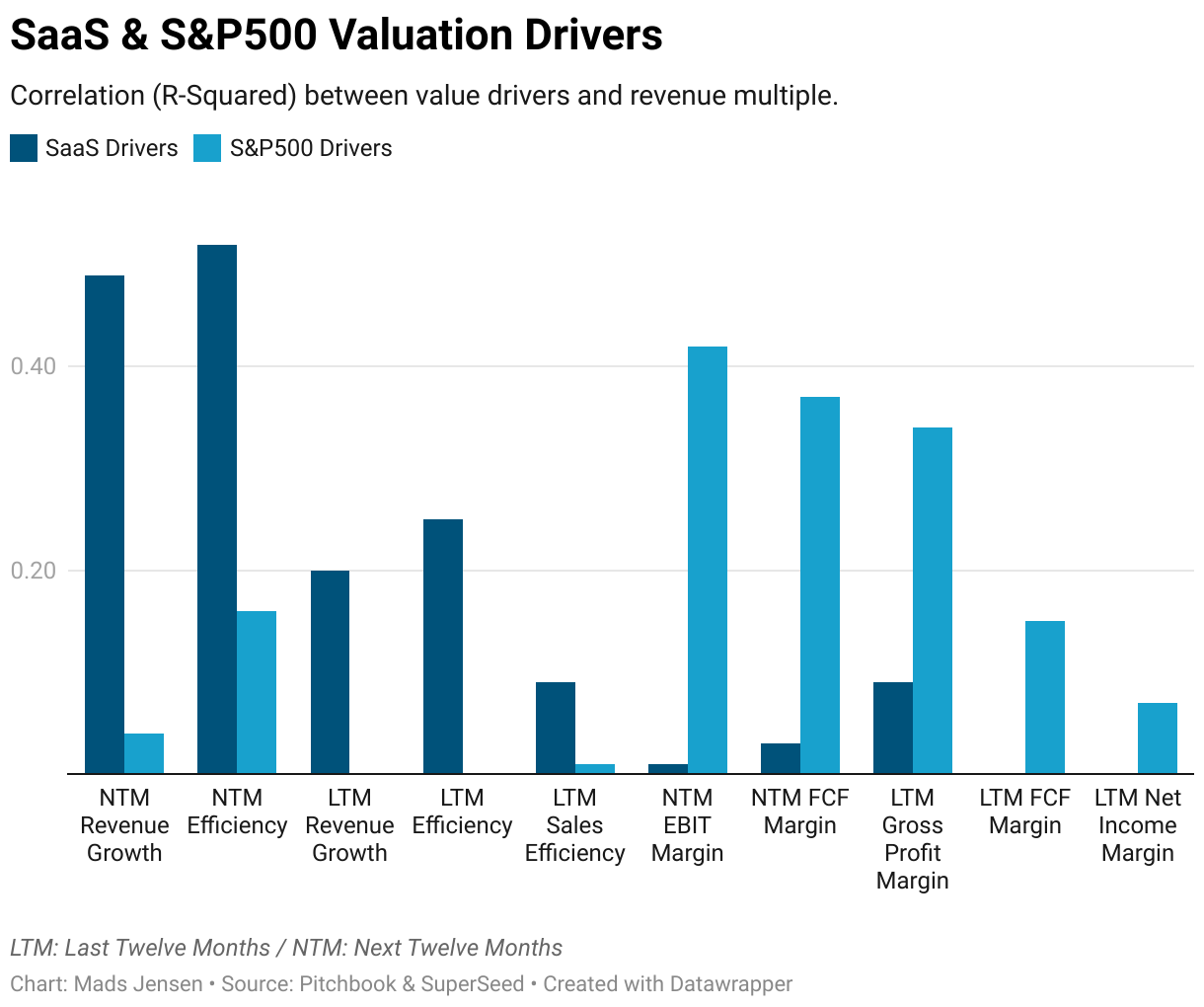
Mads Jensen compares how markets valued S&P 500 companies and public SaaS companies at the start of 2023: the former on profit margins, the latter on revenue growth, and argues the difference is mainly one of timing.
- S&P 500 valuation multiples correlated best with EBIT margin (0.42), free cash flow margin (0.37) and gross profit margin (0.34).
- SaaS company valuations correlated with revenue growth (0.49).
- SaaS companies may not be profitable today but are expected to generate plenty of free cash flow in future through high growth and high gross margins.
- The difference is described as jam today versus jam tomorrow, and in a low-growth world investors were still willing to pay for the promise of future profits.
Public SaaS companies are still valued completely differently from other companies.
Or are they?
In yesterday’s post, I looked at how markets value public #SaaS companies as we enter 2023. The conclusion is that they are valued on (capital efficient) growth.
But how does this compare to how #markets value other businesses?
At face value, it looks like they are valued completely differently.
The valuation multiples of S&P500 companies mainly correlate to profit. The three best correlations are:
- EBIT Margin (0.42),
- Free Cash Flow Margin (0.37), and
- Gross Profit Margin (0.34).
On the other hand, the value of SaaS companies correlates to revenue growth (0.49).
The two approaches appear in stark contrast. But that is only until we take a step back and consider the overlaps. SaaS companies may not deliver profit today. But they are still expected to deliver plenty of Free Cash Flow in the future. And it's a combination of high growth and high gross margins that will get them there.
So when you think about it, the difference in valuation is mainly a timing thing. Jam today vs jam tomorrow (or five years from now).
And in an otherwise low-growth world, investors are still willing to pay well for the promise of future profits.
Frequently Asked Questions
Why are SaaS companies valued on growth rather than profit?
Because even if they are not profitable today, investors expect them to deliver plenty of free cash flow in the future, and it is the combination of high growth and high gross margins that will get them there.
Which metrics best explained S&P 500 valuation multiples at the start of 2023?
According to the post, EBIT margin had the strongest correlation (0.42), followed by free cash flow margin (0.37) and gross profit margin (0.34).