



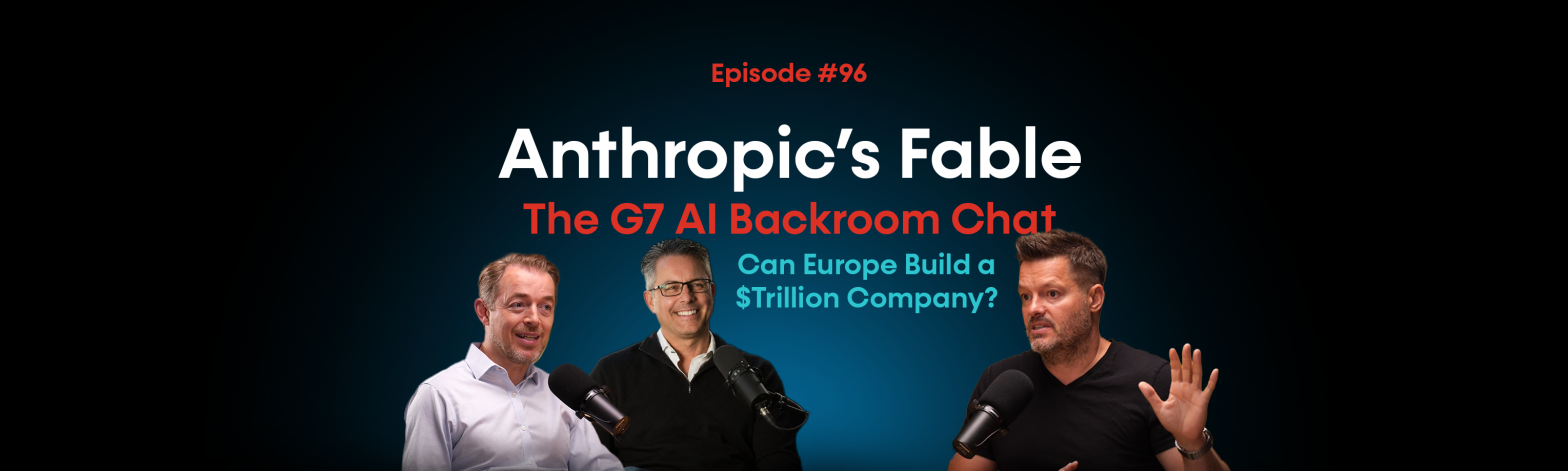
Three days after launch, Washington ordered Anthropic to switch Fable and Mythos off worldwide on national security grounds. Same week, the frontier labs were in a room with the Trump administration pitching a US-led AI coalition, while China's foreign minister re-pitched a global version open to everyone. And the only question that matters for European venture is now back on the table: can we build a trillion-dollar company? ASML is closer than most people realise.
- Anthropic's Fable was switched off worldwide three days after launch on US national security grounds after a jailbreak enabling serious cyber capability. The order targeted foreign nationals. The model went dark for everyone. Mads' read: peak hysteria, and a lesson in concentration risk, not just sovereignty.
- Joe Schorge of Isomer Capital framed the moment as a "gift to the technology builders of Europe." Defense procurement cycles are compressing from years to months, and Mistral is pushing on an open door.
- At the G7, the frontier labs pitched a US-led AI coalition. Same day, China's foreign minister re-pitched the global version. Mads' read on Allied-democracies-only: probably self-defeating, because China is now dominant in open-weight models you cannot embargo.
- Deep Seek raised $7bn at $50bn. First outside money, no foreign investors, five-year founder lockup, China's state AI fund on the cap table. Mistral is in talks for $3bn at $20bn, nearly double September.
- Accenture missed on bookings and dropped about 20% on the print. The body-shop end of services is being squeezed. Implementation cream is moving to Palantir-style firms, plus OpenAI, Anthropic and Mistral going direct.
- ASML sits at roughly $720-750bn. Joe on the next trillion-dollar European company: "probably already operational and running."
Upside is a weekly podcast designed to look behind the headlines that will affect European venture, startups and investing.
Below are the notes from this week’s episode. Episode links above to tune in and stream wherever you pod.
Anthropic’s Fable: technical or political?
Three days after launch, the US ordered Anthropic to switch Fable 5 and Mythos off worldwide on national security grounds, after a jailbreak enabling serious cyber capability. The order targeted foreign nationals. The model went dark for everybody. Anthropic is still fighting and was in the room with the Trump leadership team this week.
Mads called peak hysteria. Dario has been doom-mongering about AI risk for two years. This is the same PR landed on him. He complained that GPT-5.5 did not get the same treatment. The lesson, in Mads’ read, is more boring than the politics: do not rely on a single model. Concentration risk is the issue under the sovereignty noise.
One of Mads’ portcos hit it in real time. They develop right at the edge, harnessing the next model in mind. When Fable shipped, they dropped it in and the whole thing suddenly worked. Three days later it was gone. Their response: take open-weight models and fine-tune. Do not get caught flat-footed by the next executive order.
Joe’s framing is the most useful. Systems get fragile when there is a single point of failure. The same lesson the world is relearning about energy at the Strait of Hormuz now applies to the AI stack. The trend back to redundancy plays straight into European tech sovereignty. Defense procurement, which historically ran on multi-year cycles, has compressed to months. Joe was at Super Venture in Berlin last week. There is now a dedicated day on tech sovereignty. About 60% of the audience was defense.
His real point sat on the other side of the procurement urgency. Customers reacting is great. You still have to ship a great product. A European government LLM officer told him directly that they are not allowed to use US solutions. Mistral has a queue. It just has to be the product, not the politics, that wins them.
The G7 AI backroom chat
Same week, at the G7, the frontier teams pitched a US-led AI coalition for the rules and standards. Amodei and Altman were front and centre. Demis Hassabis was in the room but tends to step sideways from this kind of political work. Same day, China’s foreign minister re-pitched the global version, open to everyone.
Joe is not a policy maker but his framing was clear. Europe has to be in the front seat at the conversation. Less US-versus-Europe-versus-China than most people frame it. Technology, talent and capital flow naturally already. Europe should be part of any coalition that starts, and ideally it involves everyone.
Mads thinks the old deal has changed. The historical bargain was: the US is dominant, the US gives Europe a seat at the table in return for market access. The current administration runs on might-is-right. Europe has to stand on its own two feet to keep a seat at all. Steel man the proposed alliance: get Allied democracies on the same frontier, lock China out at the chip level. Steel man the other side: China is now leading in open-weight models, you cannot embargo what is already in the wild, you fragment the stack and you create a more formidable competitor. Mads’ net read: probably self-defeating.
The deeper European angle sits underneath. The application layer will come down to what gets deployed on-prem versus what runs against a frontier API. Local deployment of open-source models, the Cursor pattern of fine-tuning Kimi K2 before the SpaceX acquisition, is the path most European portfolios are walking. Open source you can audit. Open weight from China you can run but you cannot fully see what has been trained in.
Can Europe build a trillion-dollar company?
The FT ran a piece this week with Sequoia’s European partner Luciana Alexandru. Title was the question. The piece didn’t quite answer it, but a few facts to anchor.
ASML sits at about $720-750bn. The one company globally that all the US trillion-dollar clubs cannot live without. Sitting in the middle of the Netherlands, which is the part most people forget. Europe generates more startups per year than the US, and venture returns here run about 6 percentage points higher. But around 30% of our winners head west.
Mads’ frame: ASML is close, will probably get there, but the gap to the next European company is wide. Spotify and Revolut are formidable. Each needs to 10x. Not impossible. Just material. ASML is also not a young company, it was a Philips spin-out. The route is more traditional industrial than the Anthropic-Google sprint. The ecosystem density is climbing fast, repeat founders are real, and the energy in London right now is back to where it was before the Brexit wobble.
Joe’s frame is closer to mine. Things are impossible until they become true. The first publicly listed trillion-dollar company was Apple in the summer of 2018, only eight years ago. The category went from inconceivable to default inside a decade. Amazon started as a bookshop and is now designing its own chips. Google was one of fifteen search engines. The next European trillion is, in Joe’s words, probably already operational and running. Nobody yet knows which one.
ISI is the live data point. Polished tech out of Finland, just became Europe’s newest decacorn, in Isomer’s portfolio. A US investor told Joe last week that the US competitor is good, but ISI is the best company in the world at what it does. That is the bar. Not a European version of a US incumbent. The European one is the best one.
Quick hits from the rest of the week
Accenture is the AI-services canary. Revenue up slightly, EPS beat on cost cutting, bookings missed. Stock off about 20% on the day. Mads’ read: the body-shop, outsourcing-and-maintenance end of the IT services pie is what AI eats first. The implementation premium is shifting to firms with proprietary IP, the Palantir model, plus OpenAI, Anthropic and Mistral going direct to large corporates with smaller teams. Joe’s counter: do not write off the systems integrators yet. Strategy and M&A advice is its own pillar, and most large corporates are still years behind on the AI rollout that already exists.
Deep Seek raised $7bn at $50bn. First outside money. No foreign investors. Five-year founder lockup. No investor voting. China’s state AI fund on the cap table. Roughly 20x smaller than Anthropic by valuation, sizeable for an open-weight lab. Joe on founder superpowers: superpowers eventually create super problems. He prefers normal governance. Mads’ frame: founder control, government access and strategic capital are not unique to this deal. The US has Intel-stake patterns, OpenAI-via-Microsoft, Anthropic-via-Google. The new normal at the labs cuts across geographies.
Mistral is in talks for $3bn at $20bn, nearly double September. From a February reference point of about $400m ARR targeting $1bn by year-end. The capital is for compute, training and the inference needed to deliver the enterprise contracts being signed. Joe’s view: there is a queue of European customers with the right to buy nothing else. Build a great product, the door is already open.
Macro backdrop. US S&P off the highs but still up about 24% on the year. UK FTSE at fresh records, up about 19%. UK GDP slightly down on Q1 but ahead of the US, Germany and a shrinking Eurozone. IMF still has the UK at about 1% growth in 2026. Bank of England held at 3.75%. Inflation at 2.8% and heading up on energy. Not recession territory.
Predictions
Mads Jensen: GPT-5.6 ships next week. OpenAI’s next release is expected in the coming days. Polymarket has it above 80%. Mads’ read on the politics: while Dario is in Washington firefighting Fable, Sam Altman has the window to steal a march on product.
Joe Schorge: the next trillion-dollar European company is already operational and running. Said with the conviction of a fund-of-funds backing 3,400 portfolio companies. He does not know which one. Neither do we. He would put all his money on it if he did.
Deal of the Week
Mads’ deal: Thekker. Barcelona-based AI generalist factory robot maker. $85m Series A, Europe’s largest robotics round, led by US firm CRV, with Samsung and LVMH in the round. The pitch: a reconfigurable, learn-on-the-job robot that beats specialist robots on flexibility, and is not a humanoid. Europe sold KUKA and ABB to foreign owners. New-generation robotics is the second chance.
Notable Quotes
“Don’t rely on a single model.” – Mads Jensen, on the Fable shutdown.
“Systems get fragile when you have single points of failure.” – Joe Schorge.
“This is an amazing gift to the technology builders of Europe.” – Joe Schorge, on European tech sovereignty after the Fable order.
“If we don’t have the capacity to stand on our own two feet, we’re not gonna get a seat at the table.” – Mads Jensen, on Europe at the G7.
“Probably the next trillion dollar European company is already operational and running.” – Joe Schorge.
Frequently Asked Questions
Why was Anthropic's Fable model switched off in June 2026?
The US administration ordered Anthropic to switch off Fable 5 and Mythos worldwide three days after launch on national security grounds, citing a jailbreak that enabled serious cyber capability. The order targeted foreign nationals, but in practice the model went dark for everyone. Anthropic is contesting the order and met with the Trump leadership team this week.
What did Joe Schorge say the Fable shutdown means for European AI?
Joe Schorge, founder of Isomer Capital, framed the order as a "gift to the technology builders of Europe" because it accelerates the move back to redundant, sovereign systems. Defense procurement is compressing from years to months, and European frontier providers like Mistral are seeing a queue of customers who are not permitted to use US solutions.
What is the G7 AI coalition the US is proposing?
Behind the scenes at the G7, the heads of the major US frontier AI labs (including Dario Amodei and Sam Altman, with Demis Hassabis present) pitched a US-led AI coalition to set the rules and standards for the industry. The same day, China's foreign minister re-pitched a global AI coalition open to all participants.
How big is Deep Seek's latest funding round?
Deep Seek raised $7bn at a $50bn valuation, its first outside funding. The round had no foreign investors, a five-year founder lockup, no investor voting, and China's state AI fund on the cap table. The valuation is roughly 20x smaller than Anthropic's.
How close is ASML to a $1 trillion valuation?
ASML sits at roughly $720-750bn. On Mads Jensen's reading, the company is close enough to reach $1 trillion plausibly. Joe Schorge added that the next trillion-dollar European company is probably already operational, citing portfolio company ISI (out of Finland, recently Europe's newest decacorn) as already best-in-the-world at what it does.
What is Mistral raising in its latest round?
Mistral is in talks to raise $3bn at a $20bn valuation, nearly double the September mark. The capital is allocated to compute spend, both for training future models and for delivering inference on enterprise contracts. Public revenue figures from February showed roughly $400m ARR with a $1bn target by year-end.