



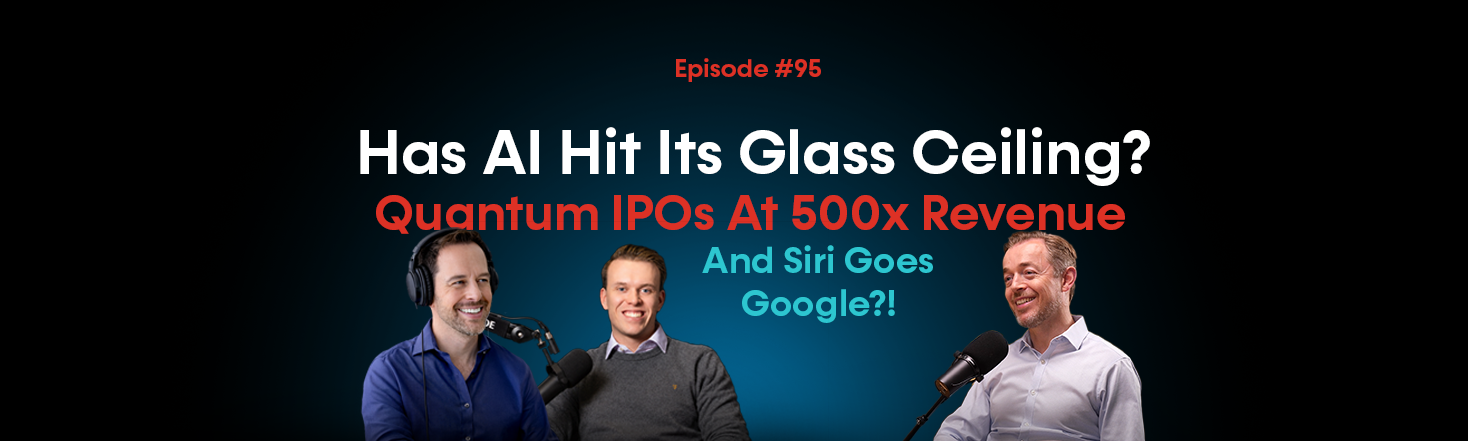
Anthropic shipped the most capable model anyone can buy this week, then deliberately constrained it. Mythos stays gated to a small set of vetted institutions; Fable, the version released to everyone else, is the same underlying model with guardrails on top. Quantum picked the same week to go public in size, with OQC's £260m round in private markets and Quantinuum, IQM and Quobly lining up the public end. Apple signed Gemini into the next Siri for roughly $1bn a year. The frontier is shipping; the question is increasingly who is allowed to use it.
- Fable is the most powerful model anyone outside a vetted group can run. It scores 80% on SWE-bench against GPT-5.5's 59%. The same model in its un-guardrailed form, Mythos, remains restricted to a small set of vetted institutions including the UK AI Safety Institute and the EU's ENISA, which got access on 2 June.
- Anthropic claims 95% of sessions never hit a guardrail. At the volumes these models now process, the residual 5% is a very large number of constrained interactions. Andrew Scott: every AI launch now sounds "less like a product announcement, more like a controlled release."
- Quantum had its capital markets moment. OQC raised £260m in Europe's largest private quantum round led by Bullhound Capital. Quantinuum priced at roughly $16bn, IQM took the SPAC route, and Quabley closed €150m.
- Callum Stewart's quantum timeline: quantum advantage in computing arriving this year or next; commercial use cases roughly 18 months to two years out; the sector's ChatGPT-style breakthrough most likely in 2028-29.
- Apple's new Siri runs on a custom Gemini variant for approximately $1bn a year, inside a private Apple cloud so Google sees no user data. The tells are price (materially below competing quotes) and architecture (private cloud, not a hosted API).
- SpaceX began trading on Friday at $135 per share, $75bn raised, 3.5x oversubscribed, a $1.8tn valuation. OpenAI confidentially filed for an IPO targeting more than $1tn. The ECB hiked 25 basis points; Brussels rubber-stamped the AI Act loosening.
Upside is a weekly podcast designed to look behind the headlines that will affect European venture, startups and investing.
Below are the notes from this week’s episode. Episode links above to tune in and stream wherever you pod.
Anthropic’s glass ceiling
The Fable release is the cleanest signal of the new shape of the frontier. The model that ships to enterprise customers is the same underlying system as Mythos; the only difference is a guardrail layer that intercepts high-risk queries and substitutes a less capable Opus 4.8 response. Fable’s 80% on SWE-bench against GPT-5.5’s 59% is the biggest single-step gap in the SWE-bench era.
Andrew’s framing was the sharpest: Anthropic built a more powerful model, then built one it does not fully trust. The bottleneck is no longer raw intelligence but confidence in releasing the capability. Every AI launch now reads less like a product announcement and more like a controlled release. Callum added the operational test: Fable was reportedly jailbroken within 24 hours of launch. If the constraints are circumventable that quickly, the meaningfulness of the segregation gets harder to defend. Andrew also raised the deeper architectural concern: these systems remain next-word prediction machines without a persistent model of causality, intent or truth, and each new safety layer may be compensating for the same underlying limitation.
The economics are not trivial. Fable is expensive; Callum’s read is that the launch pricing is unlikely to be the steady-state. D-Matrix’s Corsair chip, which moves compute into memory and removes the memory-wall shuffle, entered full production this week. Whether the next-generation inference stack lands as cheaper inference or as more capability per dollar is the open question.
For Europe, the timing is inconvenient. The UK AI Safety Institute had Mythos in pre-deployment review long before ENISA received access on 2 June. CATA, the proposed sovereignty-tiering framework we covered last week, would place Mythos outside the permitted set for tier-three workloads, and does not bind until 2028-29. By then, as Callum noted, an open-weight model of similar caliber may be available for European repurposing. The bureaucratic timeline is its own safety valve.
Quantum lifts off
This was quantum’s biggest single week in the public markets. Quantinuum priced at roughly $16bn, IQM listed via SPAC, Quobly closed €150m, and OQC raised £260m in Europe’s largest private quantum round to date. The Bullhound thesis behind OQC is that quantum has cleared its first inflection: the technology works, the question now is commercial deployment.
OQC’s specific position is co-located, ring-fenced quantum capacity inside enterprise data centres. The architecture is superconducting, which solves some scaling problems and acts as a wedge into customers (governments, banks) who want quantum without becoming quantum specialists. JP Morgan and AMD announced a financially-focused quantum-and-AI data centre in London the day after the OQC round, which gives the thesis an immediate commercial reference.
Callum’s read on the timeline is more useful than the headline valuations. Hardware progress and algorithmic progress are converging. Three papers this year (from Q-CTRL, Google and Iceberg Quantum, on top of last year’s Gidney paper) have reduced the qubit count required to crack RSA encryption by orders of magnitude. The two curves meet in 2028 or 2029, even pushed out for over-optimism. Q-CTRL also demonstrated quantum advantage in computing this year; whether that holds longer than Google’s six-month claim from the earlier cycle remains to be seen, but the framing has shifted from “is it possible” to “how soon does it commercialise.”
Andrew’s counterpoint: genuine quantum utility probably requires a million qubits, with DARPA-adjacent thinking now in the tens of millions, and the different cost bases of competing architectures (ion trap, superconducting) will become the next competitive dimension. Callum’s response: the second wave (Universal Quantum in ion traps, OQC in superconducting) is solving exactly those scaling problems, and heterogeneous designs combining modalities accelerate the commercial side faster than the prior generation.
The most under-discussed application is quantum sensing. Q-CTRL showed last year that a quantum sensor can match GPS-grade accuracy in environments where GPS is jammed or denied; if you fly Europe to Southeast Asia today, you spend at least an hour without GPS over actively contested airspace. Quantum computing pulls the headlines; quantum sensing pulls the near-term revenue.
On valuations, Callum was explicit: do not conflate private with public markets. The OQC round priced against the 2028-2029 commercialisation arc; the public-market multiples on Quantinuum and the SPACs price optionality over the same horizon at a different premium. The next 12-18 months will reveal whether the timeline holds.
Apple buys Google’s brain for Siri
The Worldwide Developer Conference deal of the week is that the new Siri runs on a custom Gemini variant, with Google paid in the region of $1bn per year. Two details matter more than the headline.
First, the price. Approximately $1bn a year is materially below what competing providers reportedly quoted. Apple negotiated as the buyer of last resort, which, given its installed base, is the inverse of the actual leverage. Google priced for distribution; Apple priced for control.
Second, the architecture. The model does not run on a hosted Google API. It runs inside a private Apple cloud, with Google explicitly cut out of the data path. For Apple, this preserves the privacy positioning that the rest of its consumer narrative depends on. For Google, it accepts the distribution gain even where the user data is no longer the upside. That trade-off is itself a signal about where the strategic value sits at the application layer of consumer AI.
The follow-on question, raised on the pod by Callum, is whether sovereign or local models become a viable alternative to the Apple-Google arrangement for European deployments. The technology is converging fast enough that the answer is plausibly yes within the CATA implementation window; the commercial answer depends on who does the integration work Apple just did.
Quick hits from the rest of the week
SpaceX began trading on Friday 12 June at $135 per share, $75bn raised, 3.5x oversubscribed against more than $250bn of demand, $1.8tn valuation (Morningstar fair value $780bn). Andrew’s read: Starlink is the engine, with the next satellite generation aiming at 5G globally and a potential pull of hundreds of millions of mobile-network users; long path to validate the trillions. Secondary effect: roughly 4,000 SpaceX employees become multimillionaires, around 400 worth over $100m each, almost all working-age and risk-on.
OpenAI confidentially filed for an IPO targeting more than $1tn, days after Anthropic. Andrew noted ChatGPT still leads on users, but Anthropic’s product cadence (about 50 releases in April alone) is starting to compound.
Bending Spoons opens its IPO book on Monday targeting $20bn, roughly double the October mark. Roll-up of AOL, Vimeo, WeTransfer, Eventbrite, 1,000 further targets identified. US listing is the recurring verdict on Europe’s public markets.
ECB hiked 25 basis points to 2.25%, first move up since September 2023; 2026 inflation projection 3.0%, peaking 3.4% late 2026.
Britain’s sovereign AI week. Cosign announced Lumen Sovereign, a UK-soil model built by upcycling open weights with post-training, with 500,000 GPU hours from Isambard AI and MOUs (design inputs, not contracts) from BT, BAE, NatWest, Lloyds and HSBC. The £1.1bn hardware package includes £750m for an Edinburgh supercomputer (2030) and £400m for chips, of which £150m buys UK inference chips this summer. Andrew was explicit that sovereign models are non-negotiable but skeptical about consortium structures; he would have preferred large tenders to two or three vertically integrated UK companies. Callum framed the goal as a sovereign bargaining chip rather than a copy of Mistral, citing Eleven Labs, DeepMind, Ineffable and Multiverse Computing.
The British Business Bank made its largest-ever single-fund investment to Playground Global, a Silicon Valley firm focused on the UK. Andrew was openly frustrated the cheque did not go to a UK fund, flagging the same concern with ARIA’s partnership with 50 Years. Callum agreed Playground was a strong pick, pointing to its D-Matrix work as the kind of engineering-leadership UK founders need.
Brussels rubber-stamped the AI Act loosening. High-risk compliance pushed to December 2027, embedded AI to 2028, machines excluded; MedTech stays in. Council-level unblock from Friedrich Merz. Correction: the original block came from the Council, not Parliament (episode 89).
Predictions
Callum Stewart: quantum has its ChatGPT moment in 2028, possibly 2029. “I can see Quantum having a chat GPT moment in sort of the twenty eight time window, maybe twenty nine.”
Callum Stewart: commercial quantum use cases in 18 months to two years. Quantum advantage in computing this year or next; commercial conversion 18 months to two years. Sensing is already in production testing.
Deals of the Week
Andrew Scott: ISI. Series F at over $10bn, led by General Catalyst. World’s largest commercial SaaS satellite operator: at least $250m in revenue, $100m EBITDA, contract backlog over $1bn, scaling to 50-100 satellites a year by 2028. Another data point that Europe is closing the gap in satellite build, even where it still lags on launch.
Mads Jensen: Neura Robotics. €1.4bn at €7bn on Wednesday, with Tether, Qualcomm, Amazon, Nvidia, Bosch, Schaeffler and the EIB on the cap table. 6,000 units expected this year against a €1bn+ order book. David Reger called it Europe’s last chance to produce anything meaningful again. Callum’s add: European robotics deployment is consistently underrated; ABB and KUKA are the historical reference points, both now under foreign ownership.
Callum Stewart: the IPO trifecta. No single pick; the week itself. A quantum IPO, a space IPO going live today, only fusion missing.
Notable Quotes
“Every AI launch sounds less like a product announcement, more like a controlled release.” – Andrew Scott, on Anthropic shipping Fable.
“I can see Quantum having a chat GPT moment in sort of the twenty eight time window, maybe twenty nine, that then accelerates everything even more than what we thought before.” – Callum Stewart.
“Let’s not conflate private with public markets.” – Callum Stewart, on the OQC underwriting discipline.
“You can’t win the race if you’ve got the brakes on.” – Andrew Scott, on European AI safety regulation.
“I’m immensely frustrated, I’m not going to lie, that this money’s gone to a non-UK fund.” – Andrew Scott, on the BBB’s commitment to Playground Global.
Frequently Asked Questions
What is Anthropic's Fable model and how does it differ from Mythos?
Fable is the publicly-available version of Anthropic's Mythos model, released this week with a guardrail layer that intercepts high-risk queries and substitutes a less capable Opus 4.8 response. The underlying model is the same. Mythos remains restricted to a small set of vetted institutions including the UK AI Safety Institute and the EU's ENISA, which received access on 2 June.
How does Fable benchmark against GPT-5.5?
On SWE-bench, Fable scores 80% to GPT-5.5's 59%. Anthropic reports that approximately 95% of sessions never hit a guardrail. Callum Stewart noted Fable was reportedly jailbroken within 24 hours of launch.
What was OQC's £260m round and who led it?
OQC raised £260m in Europe's largest-ever private quantum round, led by Bullhound Capital. The investment principal was Callum Stewart, a former Cambridge quantum PhD. OQC's thesis is co-located, ring-fenced quantum capacity inside enterprise data centres, with a JP Morgan and AMD project in London announced the day after.
When does Callum Stewart expect quantum to deliver commercial value?
Quantum advantage in computing this year or next, commercial use cases 18 months to two years out, ChatGPT-style breakthrough in 2028 or 2029. Quantum sensing is already in production testing, including GPS-grade navigation in denied environments.
What is Apple paying Google for the new Siri?
Apple is paying approximately $1bn per year for a custom Gemini variant that powers the new Siri. The model runs inside a private Apple cloud rather than a hosted Google API, which means Google does not see the data flowing through Siri. The price is materially below what competing providers reportedly quoted.
What is in the UK government's £1.1bn AI hardware package?
The package includes £750m for a national supercomputer in Edinburgh due in 2030, £400m allocated to chips (of which £150m is committed to purchasing UK-designed inference chips this summer), and the British Business Bank's largest-ever single-fund investment to Playground Global. Alongside the hardware plan, Cosign announced Lumen Sovereign, a UK-soil model built by upcycling open weights with additional post-training.