


TL;DR
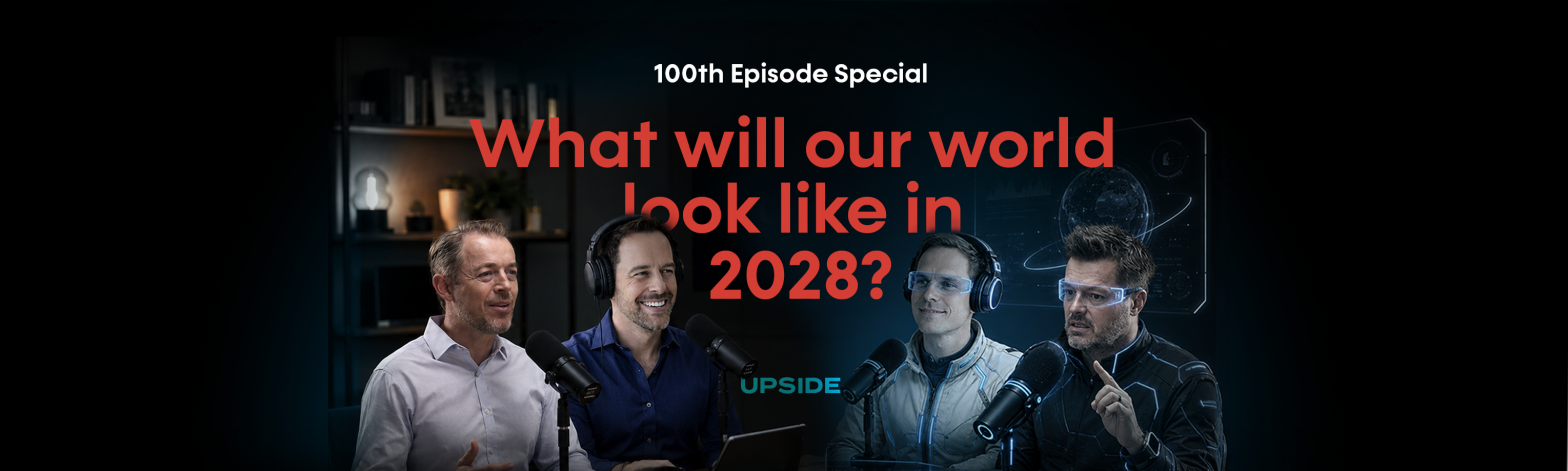
Two years and four days after episode one, the whole Upside crew, Dan, Mads, Lomax and Andrew, sat down to measure the distance travelled. The S&P is up 34%, Anthropic is up 52x, and Europe's absolute numbers all went the right way while its share of global venture halved from 16% to 8%. The real argument was about episode 200 in July 2028, where four VCs disagreed loudly about smart glasses, quantum, space and whether Europe finally stops copying America.
Key Takeaways
- Everything changed and nothing changed. Anthropic ran from $18.4bn to $965bn, roughly 52x, while Bitcoin, oil and gilts went nowhere and the boom-or-bubble question is the exact one we asked in episode one.
- Europe won the founder argument and lost the capital argument. Unicorns, decacorns and funding all grew, yet Europe's slice of global venture halved to 8%. Andrew's line: Europe doesn't have a startup problem, it has a trillion-euro pension allocation problem.
- The room split hard on the trajectory. Lomax fears an "emigrant thesis", great people, not enough risk capital, goalposts moved by the US. Mads took the other side: eight new decacorns in two years and the tide turning.
- For episode 200, the bets are down. Dan: Bitcoin sub-20k, Apple and Google win AI. Lomax: smart glasses arrive, quantum gets a winter. Andrew: at least one big LLM money-eater in serious trouble, and energy the binding constraint.
- The week was a microcosm. ASML and TSMC printed records, IBM had its worst day since 1972, and tech sold off live as we recorded.
Listen to this episode
Upside is a weekly podcast designed to look behind the headlines that will affect European venture, startups and investing.
Below are the notes from this week’s episode. Episode links above to tune in and stream wherever you pod.
The week that framed the milestone
The week made the point for us before we even started. EU Inc, the volunteer push for a single pan-European business entity, is trying to get five non-negotiables into European law by year end, including free choice of registered office, one central EU registry, and standardised stock options. Think of it as the federal overlay US business has and European business doesn’t. Elsewhere, Fable 5 is going metered, Mira Murati’s Thinking Machines shipped a 975-billion-parameter model called Inkling, Uber is circling Delivery Hero at around $15bn, and Yann LeCun stood up a fund then hit the kill switch in about ten seconds, apparently drowning in conflicts.
The one I’d flag hardest is European. Eli Lilly agreed to buy Atai Beckley for up to $3.8bn, chasing a DMT-based nasal spray for treatment-resistant depression. Lomax’s read: a big week for a sector that has seen almost no new mental-health medicines in thirty years, with J&J’s ketamine spray Spravato already heading toward blockbuster status. Biotech was dead two years ago. It isn’t now.
Earnings pulse: the AI trade splits the tape
Records on both sides of the ledger. ASML has bookings into 2028, TSMC guided roughly 40% growth with capex set to run well above the last three years, and SK Hynix sees a memory shortage past 2030. Everyone in the supply chain can see growth as far as the eye can see, and the market has quietly stopped paying for it. Samsung posted a Q2 operating profit around nineteen times higher than a year earlier, and the stock still fell 6%.
Then IBM, worst day since 1972, down 25%, after a new mainframe launch missed its own guidance. The read: enterprise spend is shifting from mainframe hardware to AI, and AI is the tool that will migrate those workloads onto cheaper platforms. Mads, who worked at IBM when it had five Nobel laureates on staff, was affectionate but blunt. A company that had it all and let the finance department demand payback within a quarter. Google, he noted, has been caught flat-footed twice in three years. Incumbency is a hard drug to quit. As for Korea, the KOSPI ran from 2,500 in April 2025 to 9,000 and back to 7,000 on the sell-off, with Samsung and SK Hynix over half the index and trading at five to six times earnings. Andrew’s clean loop: shortage creates profits, profits create capacity, capacity destroys profits. The only hard part is timing.
Episode 1 vs episode 100: two years by the numbers
Start with America. The S&P went from roughly 5,600 to 7,500, up 34%. US rates dropped from 5.5% to 3.5%. Inflation sits around 3.5%, having peaked at 4.2%. Unicorns crept from about 650 to 750, with 90 minted in the first half alone. H1 US venture funding hit $400bn, and 87% of it went to AI. That is a genuinely nuts number.
The headline names tell it better than the aggregates. Nvidia went from $3.2tn to $5.1tn, up 60%, less than I’d have guessed. OpenAI was worth $60bn two years ago and, S-1 now filed, sits near $850bn. Anthropic went from $18.4bn to $965bn. Hyperscaler capex roughly tripled, from about $240bn in 2024 to something like $680bn today.
Europe, UK included because I never know where else to put it, grew too. The FTSE is up around 27%, roughly 8,200 to 10,500. The Stoxx Europe 600 is up 23%. European unicorns went from 500 to 717, decacorns from a handful to 11, eight of them genuinely new. H1 venture funding rose 53%, from €29bn to €45bn. AI’s share of European VC jumped from 18% to about 54%. Revolut went from $45bn to $75bn, Helsing from a €5bn raise to raising at €18bn.
And then the number that stings. Europe’s share of global venture halved, from 16% to 8%. Bitcoin went from 60 to 60, having touched 125 in between. Chinese open-weight models went from nowhere in the public mind to more than 60% of open-weight token usage. Everything changed. Nothing changed.
The argument we actually had about Europe
Here’s where it got spiky. My takeaway, and Mads agreed, is that Europe has proven the quality of its founders beyond argument. Whoever ends up funding them, the talent question is settled. Andrew sharpened it: Europe doesn’t have a startup problem, it has a trillion-euro pension allocation problem. We’re producing champions and still losing global relevance because the capital that should back them sits parked.
Lomax went darker. His worry is an emigrant thesis, Europe as a place that produces unbelievable people who then need to go elsewhere to matter, because the goalposts keep moving with American scale. Growing 50% a year feels great until you realise the share number went from 16% to 8% anyway.
Mads took the other side, hard. Eight new decacorns in two years is twice what Europe managed in all prior history combined. Serious founders saying they want to build here has exploded, and US capital coming in only validates the quality. The tide, he argued, is turning. Lomax’s counter stuck with me: how many decacorns did the US mint in the same window? The bar keeps moving. Still, he upsided us before the close. Germany is getting defence right, and Proxima Fusion went from a pre-seed startup to a €2.5bn company with a German-government offtake arrangement, close to unheard of. Multiply that ten times across the continent and the picture changes.
Episode 200: four VCs bet on July 2028
This was the fun bit. Everyone put chips down.
My three. Bitcoin is on its way to structurally irrelevant, sub-20k by 2028, and yes, I own that this is projection because I lost a hundred quid to Mads on Trump. Apple and Google win AI. Apple owns personal, on-device, and after using iOS 27 Siri I finally think it’s at promise, clumsy but genuinely useful. Google owns enterprise on distribution alone, while Microsoft keeps doing Clippy and Copilot awfulness. And SpaceX halves by Christmas after its IPO, then bounces back to list price by 2028 as critical sovereign infrastructure, whatever that means with a Democrat in the White House and Elon in the picture.
Mads stayed consistent, which Lomax lovingly pointed out he always is. Pension allocation to venture still under 2% in two years, because it’s too hard to move at scale. No AGI by 2028, but frighteningly close to genuinely smart models. Fable is already scarily intelligent, the kind that tells you what you meant before you finish asking. On the two-horse race, Anthropic feels a fairly safe bet to stay above the fold, OpenAI he honestly can’t call.
Lomax pinned two colours to the mast. Smart glasses become a real thing by 2028, the form factor of the future, and he reckons we’ll all be wearing them because they’ll double as our normal glasses. I firmly disagree, which is the point of the exercise. His second call was tougher because he and Andrew have a horse in it: a quantum winter is coming. IonQ at $25bn, Quantinuum at $20bn, D-Wave and Rigetti around $10bn each, PsiQuantum near $10-12bn, none with real revenue yet. He’s seen this movie before, when D-Wave and Rigetti got recapped five or six years ago.
Andrew agreed on the quantum shakeout, a coming test of which companies can draw a line from their tech to actual utility. Then three bigger calls. Tech is now foreign policy, the economy is splitting into competing technology blocs, so by 2028 the question is as much whose technology it is as whose is best. At least one of the biggest LLM money-eaters may be in serious trouble, on funding and on literal electrical power, because every AI strategy is now an energy strategy. And Europe, specifically the UK, will finally internalise that dependence on the US isn’t a strategy, feeding defence, a recognition that Mistral alone isn’t enough, and a belated wake-up on space. His stat: the US did around 180 orbital launches in 2025 and roughly 2,500 tons to orbit. Europe managed eight launches and about 140 tons.
Deals of the Week
Mads: Valerian. A $50m Series A led by NEA. Founders Max Buchan and Josh McLaughlin, the latter ex-Special Forces and twelve years at Palantir, with Nick Trim ex-Darktrace. The pitch is the anti-Palantir Palantir, built by Europeans. It works on your data and adds AI layers but stays sealed on your own infrastructure, holding no data and no keys, so you can run open models on state secrets. Delivering across four continents already.
Dan: micro AGI. A $55m seed led by Hummingbird, Northzone, LocalGlobe, Village Global and Red Alpine. The largest seed round in German history, which is why I wanted it on the mic. Software only, no hardware in that number, helping machines understand the physical world for people building robots. Andrew seconded it, on the SuperSeed view that robots are now a software problem.
Lomax: Eli Lilly buying Atai Beckley. Up to $3.8bn, a monster European exit, and the clearest signal yet that psychedelics-for-mental-health is reaching clinical read-out and real capital.
Notable Quotes
“Everything’s changed and nothing’s changed.” – Mads Jensen, on two years where Anthropic ran 52x while Bitcoin, oil and gilts went nowhere.
“Europe doesn’t have a startup problem, we have a trillion-euro pension allocation problem.” – Andrew Scott, on why European champions still lose global share.
“I do worry that Europe is becoming a kind of emigrant thesis. We’re producing unbelievable people, and it’s very, very hard against a backdrop of not being able to put risk capital to work in meaningful quantities.” – Lomax Ward.
“Shortage creates profits, profits create capacity, and capacity destroys profits. The cycle is simple. It’s a timing question.” – Andrew Scott, on the memory supercycle.
“Fable is scarily intelligent. It’ll often say, I don’t think you meant that, Dan, I think you meant this. It’s an unreasonably smart, scary gift.” – Dan Bowyer.
Frequently Asked Questions
By absolute measures it grew strongly. European unicorns went from 500 to 717, decacorns from a handful to 11, and H1 funding rose 53% from €29bn to €45bn. But Europe's share of global venture halved from 16% to 8% over the same period, because US scale, led by OpenAI and Anthropic, grew far faster.
Anthropic went from a $18.4bn valuation to around $965bn, roughly 52x in two years. OpenAI went from about $60bn to near $850bn, with its S-1 now filed. Together they absorbed most of the gap that widened between US and European venture funding.
Dan Bowyer predicted Bitcoin below 20k and Apple plus Google winning AI, with SpaceX becoming critical sovereign infrastructure. Lomax Ward predicted smart glasses going mainstream and a quantum winter repricing listed quantum names. Andrew Scott predicted at least one major LLM company in serious trouble, energy as the binding constraint, and Europe finally treating US dependence as a strategic risk.
IBM had its worst day since 1972 after a new mainframe launch came in below its own guidance. The market read it as enterprise spend shifting away from legacy mainframe hardware toward AI, with AI itself becoming the tool that migrates those workloads onto cheaper platforms over time.
Valerian is a European sovereign-data-and-AI company positioned as an alternative to Palantir, founded by ex-Palantir and ex-Special Forces operator Josh McLaughlin with Max Buchan. It runs sealed on a customer's own infrastructure, holding no data or keys, which makes it usable for state secrets. NEA led a $50m Series A.