



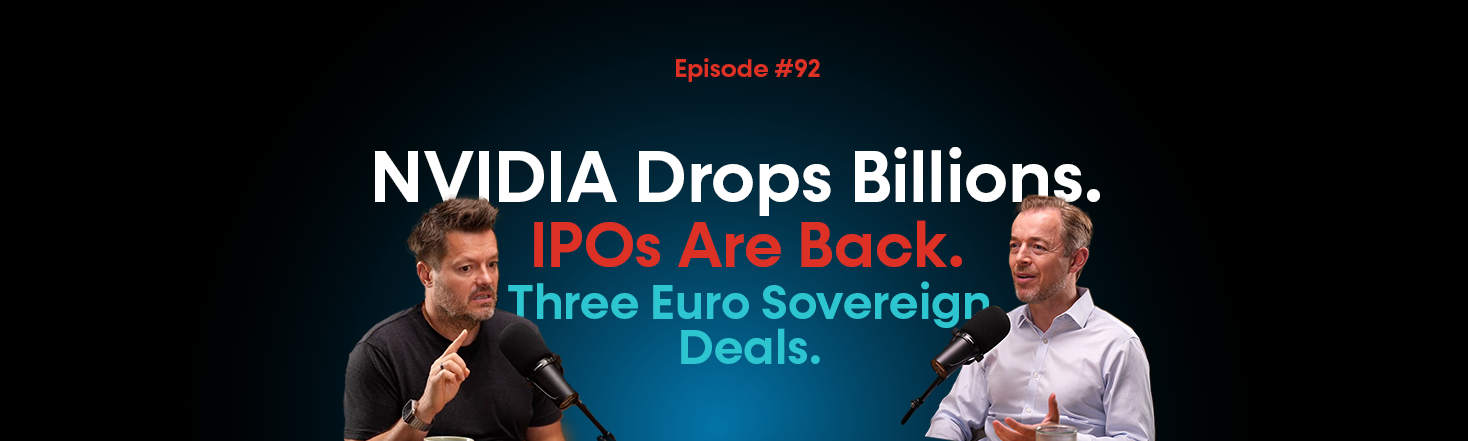
Nvidia is returning roughly $80bn to shareholders this year because the cash is arriving faster than it can be deployed. SpaceX, OpenAI and Anthropic all filed or signalled IPOs on the same day, the most consequential single moment for tech listings in a decade. While America argues with itself about AI, Europe quietly booked three sovereignty wins in a single week.
- Nvidia generated $49bn of free cash flow last quarter and is handing roughly $80bn back to shareholders this year. The FY28 forward P/E of 19 reads like market disbelief that the growth can continue.
- SpaceX filed publicly on the 20th targeting a $1.75-2tn valuation and a $75bn raise. OpenAI started filing the same day at a $1tn target. Anthropic disclosed $11bn ARR in Q2, up 130% quarter-on-quarter with a first operating profit, and is considering an October listing.
- Unitree's $67bn Shanghai IPO matters. Sub-$20k humanoids, more than 5,000 units shipped, and hundreds of millions going into an embodied large model trained on the data those robots send back.
- Three European sovereignty deals landed in one week. Mistral acquired Austrian neural-surrogate company EMI. The EIC awarded EQT the €5bn scale-up Europe fund mandate over Atomico, Eurazeo and Vitruvian. HMRC handed London-based Quantexa £175m on a ten-year sovereign data and AI contract.
- AI now polls worse than ICE in the US, with 69% not trusting government to regulate it. Europe's starting position is different. The lesson is to solve the household energy bill before the data centres turn up, not after.
- Deal of the week is Isomorphic Labs, the London DeepMind spinout, raising a $2.1bn Series B led by Thrive at a reported $15-20bn valuation. Second largest biotech round ever.
Upside is a weekly podcast designed to look behind the headlines that will affect European venture, startups and investing.
Below are the notes from this week’s episode. Episode links above to tune in and stream wherever you pod.
Nvidia is handing back $80bn because it cannot deploy it
Nvidia’s Q1 revenue came in at $81.6bn, up 85% year-on-year. Q2 guidance is $91bn. Free cash flow hit $49bn last quarter. Stock up 19.8% year-to-date. The total return to shareholders for the year is roughly $80bn, about three months of revenue or the GDP of Tunisia.
The strange part is the multiple. Forward FY28 price-to-earnings is 19. For a company growing like this, that should not happen. Mads’s read is that it is almost disbelief. The market does not believe hyperscalers can keep adding capex past a trillion, and power is the binding constraint by year end. Fear of the future, priced today, while the cash machine prints at full tilt.
Disappointed by 85% revenue growth. Only in this market.
The IPO unfreeze is real
Three filings or signals, same day, three of the most important companies on the planet.
SpaceX
Public filing targeting a $1.75-2tn valuation, a $75bn raise, and the largest IPO in history if it lands. The rocket business is iconic and unprofitable. Starlink is the cash flow. The valuation comes from AI. As Mads put it, an AI IPO wrapped in a rocket business that is really wrapping a telecoms business.
Musk’s bet is that the gating constraint on new AI capacity is power, and the answer is to lift data centres into orbit and run them on the sun. Within three years, on his telling, most new AI capacity will be stood up in space. Directionally interesting, almost certainly wrong on the timing. The other thing the raise funds is xAI, which is burning fast. Anthropic took over one of the two Colossus data centres earlier this year in a multi-year, multi-billion deal. Everybody won except Sam Altman.
OpenAI
A filing started the same day, targeting a $1tn valuation. They raised more than $100bn earlier this year and you might ask why they need the IPO. The answer is Stargate. Half a trillion in committed capex. They need public market cash and a real bid for OpenAI shares in secondaries, which has been getting harder.
The S-1 also forces the most consequential financial disclosure in tech of the decade into daylight. Real ChatGPT subscription economics. Real inference cost per query. The actual depth of the Microsoft relationship. My bet: it is not going to be pretty.
Anthropic
$11bn ARR in Q2. 130% quarter-on-quarter growth. First operating profit. October IPO under consideration. The “final round before IPO” label has been used four times in eighteen months and the price keeps moving up, so calling this one definitive is brave. Mads thinks Anthropic must IPO and that it is the most important business on the planet today, more important than SpaceX. I am less convinced.
The plumbing matters. On Thursday next week an S&P 500 rule change deadline controls how fast newly listed companies enter the index. If SpaceX, OpenAI and Anthropic get included quickly, a meaningful slice of every passive dollar in the world reroutes to them. Worth watching.
Unitree
The smaller IPO, $67bn in Shanghai, that the European tech press will undercover. Ten-year-old Hangzhou-based humanoid robotics company. The G1, the dancing one you have already seen on a feed, ships for under $20k. More than 5,000 units out the door. Hundreds of millions from the IPO go into an embodied large model trained on the data those robots send back. The BYD playbook for humanoids. The European angle is to let the Chinese harden the hardware and build the application layer on top.
Three European sovereignty wins in one week
The part of the week that did not get the headlines and matters most.
Mistral acquires EMMI
Austrian company founded in 2024, €15m seed round, building neural surrogates for physics. The idea is to replace expensive computational fluid dynamics simulation with machine-learning models that explore a much larger design space at a much lower cost. Useful for aerospace, automotive, defence. Mistral’s second M&A in three months. Not a horizontal model fight with OpenAI and Anthropic. Vertical applications with corporate customers, model as a means rather than the product.
EIC awards EQT the €5bn scale-up Europe fund
The shortlist was Atomico, Eurazeo, Vitruvian and EQT. EQT won. Nordic base, large-fund pedigree, unicorn-heavy stable, no obvious political baggage. Europe is structurally underweight at the growth stage. Sequoia’s growth fund alone is $7.5bn. European pension funds allocate roughly 0.2% to venture. US pensions sit at 25-30% in alternatives with a real venture slice inside. The point of the mandate is to seed the track record that crowds the pension money in. A decade-long bet. The right bet to make.
HMRC awards Quantexa £175m
Ten-year sovereign data and AI contract. Palantir got £900m on other UK government work, so this is not the trade most people would have made on capability alone. But Quantexa is London-based, sits in the same competitive bucket, and the contract gives a British firm the cash and the reference to compete for the next ten of these. The risk is ending up with the B player running the country’s data layer. The upside is a serious European competitor to Palantir with sovereign muscle behind it. Signal beats number.
America’s AI mood is ugly, and Europe should learn from it now
AI polls worse in the US than ICE and politicians. 69% of Americans do not trust the government to regulate it. Molotovs at Sam Altman’s house. Local councillors who approved data centre permits voted out. Eric Schmidt booed at a University of Arizona commencement. Roughly 100 community groups across 12 states organising against AI. King’s College London found 22% of Brits think AI will eliminate jobs fast enough to trigger civil unrest, about a third of the US number, but not zero.
AI usage is still rising while AI itself is unpopular. More than 5,000 US data centres, concentrated around northern Virginia, have driven household utility bills up by hundreds of dollars a year. At the same time gas is near $5 and groceries are biting. Dario Amodei has been touring the doomer story for headlines. Corporate leaders dressed up routine restructurings as AI redundancies because it sounded better than over-hiring. Populist politicians piled in.
Europe’s starting point is different. Fewer data centres, regulated utilities, lay-off rules that mean workforce stories cannot be blamed on AI casually. The lesson is portable. Solve the household energy bill question before the data centres turn up, not after. Click rage will arrive in the European press too. We have time to be ready.
Predictions
Dan: France rewrites its ESOP and stock-option tax rules by the end of 2026. A senior Mistral researcher resigned this week, joined Anthropic in the Bay Area, and posted a long thread on X explaining why. The post is deleted, but the substance was that France is too expensive on tax and incentives, and the climate of debate is regressive. Mistral is the closest thing France has to a national champion in AI. My bet is Mistral forces the French government to legislate a US-style stock option regime with the tax treatment to match by end of 2026.
Mads: takes the other side. His read is that the tweet was about the spirit of the debate as much as the tax, that French intellectual culture keeps relitigating first principles when it should be building, and that Macron is too weak to push real reform through before the next election. The next government is more likely to be far-right or far-left than reformist. Either way, the fix does not land on the timeline I have called.
Deal of the Week
Isomorphic Labs raised a $2.1bn Series B. Second largest biotech round in history. Thrive led, the same lead as the Series A. UK sovereign AI funders are in, alongside MGX, Alphabet and Google Ventures. Reported valuation $15-20bn, not yet confirmed.
Isomorphic is one of the most exciting applications of frontier AI on the planet right now. DeepMind technology. AlphaFold for predicting how molecules grip. AlphaProteo for designing new proteins from scratch. Validation deals already in place with Lilly and Novartis. Nothing in patients yet, but pharma is queueing for what comes out of the pipeline. Built in London. Demis Hassabis still has a day job and, by reputation, turns up at Isomorphic at 6pm to work through to butt-munch o’clock. Long may they stay here.
Notable Quotes
“It’s bananas.” – Mads Jensen, on Nvidia’s $49bn quarterly free cash flow and a forward P/E of 19.
“It’s an AI IPO that’s wrapped in a rocket business that really in turn is wrapping a telecoms business.” – Mads Jensen, on the SpaceX listing.
“This filing will be the most consequential financial disclosure in tech of the decade.” – Mads Jensen, on the OpenAI S-1.
“It’s a more important company than SpaceX today.” – Mads Jensen, on Anthropic.
“As long as it’s not the B player.” – Dan Bowyer, on buying British in the Quantexa-versus-Palantir trade.
Frequently Asked Questions
Why is Nvidia returning $80bn to shareholders in 2026?
Nvidia generated $49bn of free cash flow last quarter and is on track to return roughly $80bn to shareholders this year. Cash is arriving faster than the business can deploy it. The forward FY28 P/E of 19 reads as market disbelief that the growth rate can continue against rising capex and a power constraint.
When is SpaceX expected to IPO and at what valuation?
SpaceX filed publicly on the 20th of May 2026 targeting a $1.75-2tn valuation and a $75bn raise. If it prices at that level it will be the largest IPO in history. The economics rely on Starlink today, with a forward bet on space-based AI data centres.
What is Anthropic's Q2 2026 revenue?
Anthropic disclosed $11bn in Q2 ARR, up 130% quarter-on-quarter, and posted its first operating profit. An October 2026 IPO is reportedly under consideration.
Why did the European Innovation Council award the €5bn scale-up Europe fund to EQT?
EQT won the mandate over Atomico, Eurazeo and Vitruvian on the strength of its large-fund pedigree, a unicorn-heavy portfolio, and a Nordic base seen as less politically beholden. The fund is designed to seed European growth-stage capital where pension allocations to venture sit at around 0.2% of assets, compared with 25-30% in alternatives at US pension funds.
Why is the American public turning against AI?
US data centre build-out (more than 5,000 facilities) has pushed household utility bills up by hundreds of dollars a year. AI now polls worse than ICE and politicians, 69% do not trust the government to regulate it, and protest activity is rising across roughly 100 community groups in 12 states. AI product usage is still rising at the same time, so the brand and the product have diverged.
What did Isomorphic Labs raise and what does the company do?
Isomorphic Labs raised a $2.1bn Series B led by Thrive at a reported $15-20bn valuation. It is a London-based DeepMind spinout that uses AlphaFold-class models to predict how molecules bind and AlphaProteo to design new proteins. Pharma validation deals with Lilly and Novartis are already in place.