



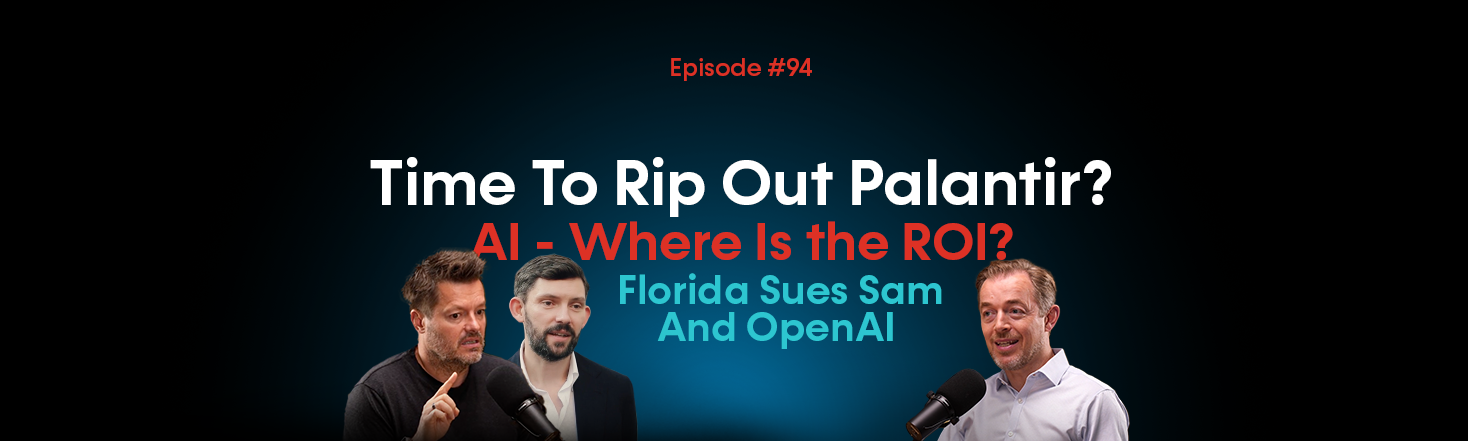
This week on Upside: venture secondaries stopped being a backwater and started looking like a $100bn market, with VenCap's Matt Russell explaining why the best deals are the ones you pay a premium for. Europe is drafting a tiering system to keep foreign kill-switches out of its most sensitive workloads, the UK is fighting over whether to rip Palantir out of the NHS, and the three biggest IPOs in history are queuing up in a single year.
- Venture secondaries are no longer niche. With roughly $3 trillion of unrealised value sitting in venture funds globally, Matt Russell thinks the venture slice hits $100bn "in pretty short order." The misconception worth killing: the best returns come from paying a premium for great companies, not buying mediocre stuff at a discount.
- Europe's CATA proposal would sort government workloads into four sovereignty tiers, from "data on EU soil" up to "full EU supply chain, no foreign interference." A proposal, not law, but it's a continent trying to design out the foreign kill-switch.
- The Palantir fight is really a lock-in fight. MPs want to tear up a £330m NHS contract and hand it to a British supplier that does not exist. Matt's answer: do not rip it out, but panic about how you build a swap-out.
- The enterprise AI ROI question is still mostly anecdote. Uber capped staff AI spend at £1,500 a month after torching its annual budget in four months, and token pricing means nobody can forecast.
- Anthropic, SpaceX and Alphabet are all raising into the tens of billions in the same year. Goldman reckons the market absorbs it, because buybacks are doing the buying and the floats are tiny.
Upside is a weekly podcast designed to look behind the headlines that will affect European venture, startups and investing.
Below are the notes from this week’s episode. Episode links above to tune in and stream wherever you pod.
What secondaries actually are, and what everyone gets wrong
Matt Russell from Vencap started in what used to be the quiet corner of private markets. Not anymore. Companies are staying private far longer, and the secondary market has become where people go for cash. The whole secondary market across private equity and venture is about $200bn at the fund level, with around $3 trillion of unrealised value sitting in venture funds globally. Venture is far younger than PE, so the runway is long: no reason the venture slice isn’t a $100bn market in short order.
Here’s the bit most people get wrong. Say “secondaries” and people picture distressed sellers and big discounts. VenCap’s experience is the opposite. Some of their best-performing deals were bought at a premium, because the prize was exposure to a great company with a lot of growth ahead, not a cheap stake in something mediocre. Secondaries follow the same power law as everything else in venture: quality and access beat a bargain. With 500 funds and 17,000 portfolio companies tracked over four decades, the book lands roughly two-thirds US, then India and China. No geographic targets, because the moment you force an allocation you invite adverse selection.
Europe writes a rulebook for the kill-switch
Brussels is rolling out a sweeping tech sovereignty package, and we’ve heard the drumbeat before. This time the interesting piece is CATA, the Cloud and AI Development Act. As Mads put it, this isn’t about building our own Google. It’s about making sure critical workloads can’t be switched off remotely or subpoenaed under the US CLOUD Act.
The mechanism is a tiering system. Sort the workloads governments buy by criticality, levels one to four. Level one means data on EU soil. Level four means a full EU supply chain with no foreign interference and no remote kill-switch. A proposal, but the direction is clear.
The backdrop is uncomfortable. Europe leans on non-European tech for 80%-plus of its services, and households park roughly €300bn a year outside the EU, mostly in the US. And while Macron does his startup-nation last hurrah at Versailles, with €110bn of AI pledges and €75bn from SoftBank, French debt is climbing toward €3.5 trillion, about 115% of GDP. The pitch is sovereignty. The balance sheet says something else.
The cloud majors are already improvising. Microsoft has licensed the whole Azure stack to European operators, Bleu in France and Delos in Germany, and Google has a Thales arrangement, 3NS. AWS hasn’t. So the open question is which of these clears level three, “owned and controlled by,” and whether a European provider could even run a US frontier model locally while licensing the IP. Nobody knows yet, and Mistral is the obvious beneficiary. Mads, predictably, dragged it back to the boring fundamentals: complete the single market, free up pension capital. That’s what moves the needle, not tinkering with legislation.
The Palantir problem is a lock-in problem
This runs straight on from sovereignty. MPs want the government to tear up Palantir’s £330m NHS data contract and hand it to a British supplier. There is no British supplier. There’s also a £240m MOD deal that went through with no competitive tender, and Sadiq Khan blocked a £50m Met deal on the side. The Dutch, Swiss and Germans are doing the same maths on their own sensitive systems.
Chi Onwurah is leading the charge in the Commons, and she’s no lightweight, possibly the only chartered engineer in Parliament, 20 years in telecoms. The lock-in worry is legitimate, because once an enterprise platform is embedded you can’t easily get it out. And the federated data platform she’s worried about delivers: it sits on top of every trust’s data, builds digital twins of how hospitals run, and by every account cuts stays and improves outcomes.
The cautionary tale is the National Programme for IT from the Blair years, scrapped in 2011 after £10bn spent and nothing to show. So the fear is real: scrap Palantir for a British thing that doesn’t exist, and you’ve commissioned another £10bn hole. Matt’s read, when I asked whether he’d rip it out as an MP, was that he wouldn’t, but he’d panic about how to build the ability to swap providers later. Mads landed it: two wrongs don’t make a right. We regulated ourselves into a thin tech sector, and now want to legislate our way out of a hole we dug fifteen years ago. Better to ask what conditions let us win the next one. It might just be Palantir for now.
Enterprise AI spend, and the ROI nobody can forecast
Companies are starting to complain about the bill. Uber capped staff at £1,500 a month each after torching its annual AI budget in four months. Pizza Hut is being sued over a system that served cold pizzas, and Starbucks built a barista vision tool that couldn’t count milk. Consumption-based token pricing means nobody can forecast spend, which is the real problem under the PR.
Matt’s framing on ROI is the right one. Long term it’s a margin thing, more productive people on higher-value work, but you can’t run that analysis cleanly while you’re still iterating, so for now it stays anecdotal. VenCap, like most firms, is in the experimentation phase. I keep coming back to a BVCA panel I did earlier this year, maybe 250 VCs in the room, where I asked who’s using AI where it’s genuinely moving the needle, embedded, not experiments. A small smattering of hands, which is a fair proxy for most businesses right now. The ROI shows up in cash flows eventually. Business just doesn’t move as fast as the people expecting a profitability bump next quarter would like.
The $80bn club
Everyone seems to be raising $80bn. Anthropic is going public and jumping OpenAI’s queue. SpaceX goes live on 12 June at near $1.85 trillion. And Alphabet is raising $85bn on top of $100bn of debt, with Berkshire in for $10bn.
Can the market absorb three of the biggest IPOs in history in one year? Goldman’s study says yes, and the reasoning is counterintuitive. IPO activity is historically low: about 100 IPOs this year against 250 in 2021 and 400 in 1999, and issuance is near 1% of market cap against a 1.5% norm. The floats are tiny, around 10% to start, and even as lockups roll off the demand holds, because corporates keep buying back their own stock. Worth noting Goldman is also running the SpaceX IPO. On their own numbers, the path to $1.78 trillion needs SpaceX’s AI revenue to grow 100x by 2030, from $3bn to $300bn. It comes down to space AI and whether people believe it lands in that window.
Matt won’t stock-pick, VenCap never has, but pushed for his last $100 he leaned where the data leans: the top 0.1% keep surprising to the upside. On Alphabet, Mads waved off the Buffett-signal reading. Buffett isn’t making this call, Greg Abel is, and the raise is capex anyway, demand needing more data centres and more hardware.
America sues its own
The usual choreography is Europe legislates, America sues. This week the table turned and America sued its own. Florida became the first state to take AI to court, suing OpenAI and Sam Altman personally for an unsafe product, off the back of a criminal probe tied to a campus shooting. Same week, Trump watered down his AI order: a 90-day mandatory review became a voluntary 30-day one.
Mads drew the useful line. Suing works when the harm is bounded and local, the kind a trial and a remedy can handle after the fact. It breaks when the harm is unbounded and has already diffused by the time you reach court, the nuclear-meltdown case. The personal naming of Altman bothered him more, and me too. Limitation of liability is load-bearing for entrepreneurship, and the bar for stripping it should stay high.
Deal of the week
Mads picked Stark, the Berlin defence-tech company raising €300m at €2.5bn. They make exactly what the Pope told everyone not to make last week: autonomous loitering munitions, plus Minerva, an AI command layer. Autonomous weapons are coming whether we like it or not, because the other side will build them. The only question is how far you lean in.
Mine was Gigaton, formerly Carbonry, a lovely boring business that helps cement, steel, glass and chemicals firms run cleaner, more efficient systems. They’ve raised $26m to build out their control systems. I love an industrial efficiency play.
Predictions
I’ll go first, since Mads doesn’t love them. Europe can’t achieve total AI self-sufficiency, and few would argue otherwise. But it will achieve strict sovereign control, and it’ll do it by splitting in two. A state tier, where government and critical infrastructure run solely in the EU on the likes of Mistral and Aleph Alpha, hosted on native cloud. And a commercial tier running tamed, legally compliant US frontier models from Anthropic and OpenAI on hived-off AWS or Azure. I think we see that two-tiering through 2027.
The follow-on is a change of mind for me. I no longer think Chinese open-source models make real inroads into regulated, data-touching workloads, not where patient records are involved. Mads pushed back, fairly: coding is the most important workload right now, and plenty of Chinese open-weight models sit in coding stacks already. So maybe in the unregulated MVP layer, just not near the patient records. And the way Matt framed the model market stuck with me: not commoditised like electricity, but like airlines, low-cost carriers at one end and premium charters at the other.
Notable Quotes
“Some of our very best performing deals we’ve paid a premium for, because it’s been exposure to a great company with a lot of growth ahead of it.” – Matt Russell, VenCap
“We’ve always been too conservative on the winners. Time and time again, we’ve undermodeled it.” – Matt Russell, on venture’s biggest outcomes
Frequently Asked Questions
What are venture secondaries and how big is the market?
Venture secondaries are stakes in venture funds or venture-backed companies bought from existing holders rather than at primary fundraise. The whole secondary market across private equity and venture sits around $200bn at the fund level. On the podcast, VenCap's Matt Russell estimated venture secondaries specifically could reach $100bn in short order, pointing to roughly $3 trillion of unrealised value sitting in venture funds globally.
What is the EU CATA Cloud and AI Development Act?
CATA is a proposed EU framework that sorts the workloads governments buy into four sovereignty tiers. Level one requires data on EU soil, and level four a full EU supply chain with no foreign interference or remote kill-switch. According to Mads Jensen, the goal is less about building a European Google and more about ensuring critical workloads can't be switched off remotely or subpoenaed under the US CLOUD Act. It is a proposal, not law.
Why do MPs want to remove Palantir from the NHS?
MPs led by Chi Onwurah want to tear up Palantir's £330m NHS data contract over data control and vendor lock-in, arguing it should go to a British supplier. The practical problem is that no equivalent British supplier exists. Matt Russell's view was that ripping it out would be a mistake, but the government should urgently build the ability to swap providers in future.
Why is Florida suing OpenAI and Sam Altman?
Florida became the first US state to take an AI company to court, suing OpenAI and naming Sam Altman personally over an allegedly unsafe product, tied to a criminal probe connected to a campus shooting. On the podcast, Mads Jensen argued the personal naming is concerning because limitation of liability is foundational to entrepreneurship, and the bar should stay high.