



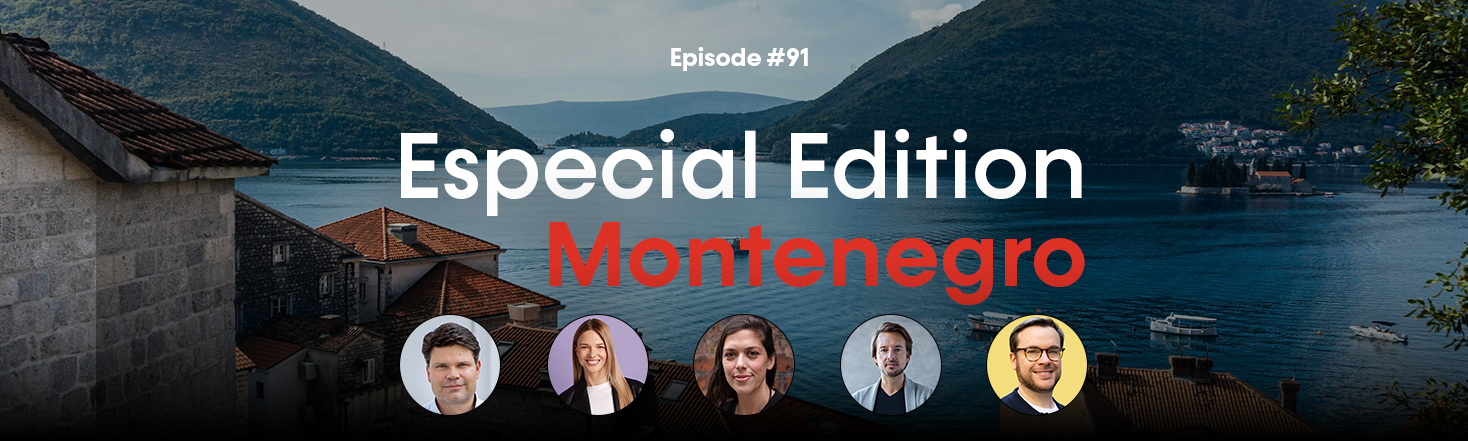
Special edition of Upside, recorded in Montenegro. I asked five European GPs the same question: if you had to put every fund euro you have ever raised and every euro you personally own on one bet, what would it be and why. The answers map the surface area of where European venture thinks the next decade actually lives. The themes that came back: the AI stack, AI for traditional businesses, deep tech climate, physical AI with a safety layer, and physical AI as a $100T addressable market.
- The European AI opportunity is not a separate continent. Jens Lapinski thinks of US and Europe as one investment continuum. Most "sovereignty" talk, in his view, is a fantasy you tell yourself before opening a Mac on the Google stack.
- The boring AI bet beats the rocket-ship AI bet. Andra Bagdonaite at FIRSTPICK is doubling down on AI rebuilding traditional SMBs in manufacturing, logistics and Excel-and-legacy-ERP shops. That is where the money lives.
- Ella Goldner's last bet is deep tech climate, executed with COVID-task-force urgency. Founder mode for climate.
- Mike Reiner at 432 Legacy maps value chains and looks for supply-demand gaps. His bet: physical AI plus a human-safety layer. ~11% of revenue is currently lost in robot-and-human environments to that single problem.
- Dave Haynes at FOV puts a number on the prize. Digital economy ~$15T, physical economy ~$100T. Robotics plus physical AI is the layer that opens the second number to software.
- Two ecosystem fixes came back across more than one answer: unlock European pension and institutional capital so it can flow into venture, and make it easier for founders to operate (including Germany's exit tax, which strands paper-rich founders inside the country).
Upside is a weekly podcast designed to look behind the headlines that will affect European venture, startups and investing.
Montenegro. Inlet, hills, sun. Format was simple. Five European GPs, five bets. If you had one ticket left, where is it going. We did go down a rabbit hole a bit, asking other questions such as – If you could change one thing about the European venture ecosystem, what would it be.
Jens Lapinski, Founding Partner at Angel Invest
The bet: the entire AI stack. Not a niche, not a single application, the whole vertical. From money-transfer AI through training environments through deployment inside large enterprises. The reason: in every layer, there are technically amazing companies doing the work.
The European angle, in Jens’ framing, is a frame error. He does not think the European opportunity is separate from the US opportunity. NATO, open commerce, free democracy. America and Europe sit on one investment continuum. China is a different country, India is a different country, the trans-Atlantic Western market is one investable thing. The chips, the LLMs, the hyperscalers, the laptops, the operating systems, the cloud stack you run your firm on – all American. Sovereignty in those layers is largely a story you tell yourself before lunch. The exceptions are real (defence is the obvious one) and worth funding. The rest of the time, ride the continuum and stop pretending we can decouple.
The one thing he would change: the plumbing of European capital. EU Inc. The pension and insurance restrictions that keep institutional money out of venture. Public market structure so European companies can go public in Europe. Move money to founders and to the next generation. Not to politicians. Politicians, in Jens’ framing, are not asset allocators. They are asset wasters.
Andra Bagdonaite, GP at FIRSTPICK
FIRSTPICK is a first-check pre-seed and inception fund backing Baltic founders. Investing since 2022, generalist by strategy, AI-led by current conviction.
The bet: the AI application layer. Specifically, AI rebuilding the unsexy stuff. The SMBs in manufacturing and logistics still running on Excel and legacy ERP. The mid-size factory. The traditional service business. The unglamorous middle of European economic activity.
Two layers underneath the thesis. First, the Baltics are a sandbox. Small enough that a founder can pilot with a company or two and prove a solution fast, big enough to validate against real customers. Founders pilot locally and go global from day one. Second, the businesses Andra wants to modernise are nowhere near agentic. They are nowhere near current-generation ERP either. The bet is that AI brings them forward several decades in a handful of years, and the value created is enormous.
Not a rocket ship. Andra was clear about this. It is a patient build over a long arc, and that is precisely where the real money tends to be made. The boring, transformative thing is the under-priced opportunity.
Ella Goldner (Levy), Co-Founder of Zinc VC and Alma-angels
Ella’s last bet is deep tech climate. Not adaptation, not carbon accounting, not incremental. A transformative, science-led innovation that meaningfully changes the direction of travel. She does not know which specific technology, but she is convinced one will appear, and that it has to be backed at the scale of the threat.
Why Europe: because we have the brains and the science to do the work. Why now: because incremental is no longer enough.
The execution model in her head is Kate Bingham’s UK vaccine task force. Take an urgent question, cut the red tape, get the system to behave like a founder. “Founder mode for climate” is the phrase. Apply that urgency to fusion, energy provision, even space-based power. Run a portfolio across moonshots. Accelerate the path from lab to commercial.
The one thing she would change: cultural ambition. In Israel, business plans get built and broken over lunch. That is not yet the European default. The fix, in her view, is not policy. It is visible founder role models catalysing the next generation. Mentoring. Investing. Creating networks. Encouraging the next set of kids to think of themselves as builders. Start in schools. Build the problem-solving mindset early. AI is an enabler for that mindset, not a substitute for it.
Mike Reiner, Founding Partner at 432 Legacy
Mike does value-chain analysis the way most investors do pipeline. His firm built internal tech that maps a market, calculates supply-demand gaps, and surfaces the choke points.
When he ran that analysis on physical AI, the gap that came back was safety. Specifically, the layer that mediates between robots and humans in shared environments. The stat: roughly 11% of revenue is lost in robot-and-human environments to this problem alone. 432 Legacy has invested in a Switzerland-based company using ultra-wideband to detect humans through walls, and is actively looking for more in the same gap.
Other examples from the same method, in passing. Data centres: the binding constraint is not energy, it is transformers and specific hardware deep in the supply chain. Cybersecurity: the long-term defensible bet is firmware security, because the frontier labs will bake the rest of the layer in. Whiskey, oddly enough: an acquaintance wanted to scale his business and the value-chain analysis pointed at barrel suppliers. Acquire the barrel maker, not the next vineyard.
The one thing he would change splits in two. First, easier life for founders. Germany’s exit tax means founders are paper-rich and cash-poor and cannot leave. He is hoping EU Inc lands as enforceable law, not as a directive. Second, quieter but louder if you sit with it: inner work for founders. The sweet spot in his model is trauma-driven and self-aware. Most VCs optimise for the trauma without the therapy. The founders he wants to back are obsessed with growing themselves, not just the company.
Dave Haynes, Partner at FOV Ventures
Dave’s frame is the cleanest. The digital economy is roughly $15T. The physical economy is roughly $100T. Software has eaten most of the first number. The opportunity for the next decade is to eat the second.
The bet: robotics plus physical AI. He separates the two. Robotics is the body – the actuator, the chassis, the operating system. Physical AI is the brain – a world model that actually understands physics, not just text and pixels. Drop a napkin on a table and an LLM will tell you it falls due to gravity. A physical AI model will simulate where it lands. That distinction is the unlock.
FOV’s mental model breaks the wave into four layers. Hardware and infrastructure (sensors, hyperspectral imaging, even wireless power – FOV invested in a company called Willow). The software and operating system stack on top. The intelligence layer, where world models live. And then the vertical applications: agriculture, health, consumer robotics.
Europe’s edge sits in two of those layers. Deep tech hardware (the talent and the labs are here). And vertical applications, because Europe has a labour shortage and a real pull from end customers who know their robot 1.0 systems can be smarter. The next wave, in Dave’s framing, is “robotics 2.0”. Where 1.0 needed €5M of CapEx to even start, 2.0 is a €500k cheque, a kid out of TUM or ETH or Imperial, and an industry to take on.
What came back twice
Two patterns appeared across more than one answer.
Unlock European institutional capital. Pension money, insurance money, public market structure. Jens went after this directly. Mike pointed at the same problem from the founder side via Germany’s exit tax. The plumbing is the bottleneck.
The opportunity is bigger than the digital wrapper. Andra wants AI in traditional businesses. Mike wants physical AI in the safety layer. Dave wants robotics in the $100T physical economy. Three different framings, one thesis. Software has eaten the easy half of the world. The hard half is next, and Europe has structural advantages on it that the headlines do not capture.
Notable Quotes
“I don’t think that there is a separate opportunity for Europe versus the US. I think it’s just part of one larger continuum.” – Jens Lapinski.
“I’m mostly excited about AI modernising the traditional businesses.” – Andra Bagdonaite.
“Imagine if we apply the same sense of urgency and all these systems coming together. Like founder mode for climate.” – Ella Goldner (Levy), echoing Kate Bingham.
“It’s around 11% of revenue that’s lost currently to a company due to this problem alone.” – Mike Reiner, on the robot-human safety layer.
“All of a sudden this opportunity to come into this $100 trillion dollar market is there.” – Dave Haynes, on physical AI versus the digital economy.
Frequently Asked Questions
Where was Upside Episode 91 recorded?
On location in Montenegro, as a special edition. The format was Dan Bowyer interviewing five European GPs one at a time on the same two questions: their single biggest bet if they had to commit all capital, and one thing they would change in the European venture ecosystem.
Which European GPs were interviewed?
Jens Lapinski (Founding Partner, Angel Invest), Andra Bagdonaite (GP, FIRSTPICK), Ella Goldner / Levy (Co-Founder, Zinc VC and Alma-angels), Mike Reiner (Founding Partner, 432 Legacy), and Dave Haynes (Partner, FOV Ventures).
What did the GPs say about European AI sovereignty?
Jens Lapinski argued that AI sovereignty across chips, LLMs, hyperscalers, operating systems and cloud is largely a fantasy because the underlying layers are American. In his view, the practical European posture is to pick the specific layers where sovereignty actually matters (defence is the obvious example) and otherwise treat the US and Europe as one investment continuum
What is the physical AI opportunity for European venture?
Dave Haynes at FOV framed it as the gap between the roughly $15T digital economy that software has already eaten and the roughly $100T physical economy that it has not. Robotics provides the body and physical AI provides the world-model brain. Mike Reiner at 432 Legacy added a specific gap inside that wave: the human-safety layer between robots and people, where ~11% of revenue is currently lost.
What is the one thing European GPs say they would change about the ecosystem?
The most common answers across the five interviews were unlocking European institutional capital (pension funds, insurance allocations, public market structure that drives European companies to list in the US) and making life easier for founders (specifically Germany's exit tax, which traps founders inside the country). Ella Goldner also raised cultural ambition, building the next generation through visible role models and problem-solving education.