


In 1987, Paul Samuelson noted that “the stock market has predicted nine of the last five recessions.” The observation landed because everyone making predictions knows the feeling: sometimes you’re right for the wrong reasons, sometimes wrong for the right ones, and occasionally you just miss.
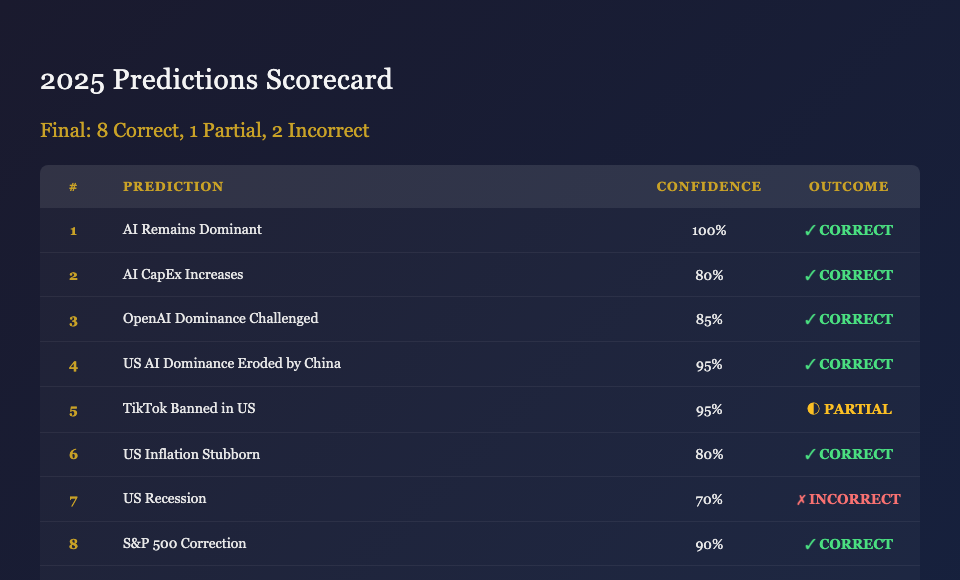
Last December, we made eleven predictions about 2025. Time to face the scorecard.
Final Score: 8 Correct, 1 Partial, 2 Incorrect
The Wins
1. AI Remains the Dominant Theme ✓
Original prediction (100% confidence): “AI will remain the dominant investment theme”
This one feels almost too easy in hindsight, like predicting the sun would rise. But consider: at the start of 2025, there was genuine debate about whether we’d hit an “AI winter.” The chatbot novelty was supposedly wearing off. Enterprise adoption was “disappointing.”
Then Anthropic’s Claude started autonomously refactoring codebases for seven hours straight. And Andrej Karpathy—the man who literally co-founded OpenAI—wrote that he’s “never felt this much behind as a programmer.”
When the people building the frontier are themselves astonished, you’re witnessing something real.
Verdict: CORRECT (and possibly the understatement of the decade)
2. AI CapEx Continues to Surge ✓
Original prediction (80% confidence): “Cloud providers will continue aggressive infrastructure investment”
We expected spending to increase. We didn’t expect $405 billion.
Microsoft alone committed $80 billion to AI data centres. Project Stargate announced $500 billion in planned investment, with $100 billion deployed immediately. Goldman Sachs projects $1.15 trillion in cumulative AI CapEx through 2027.
The hyperscalers aren’t hedging their bets—they’re all in. When companies with the world’s best capital allocation track records collectively decide to spend this aggressively, it’s worth paying attention.
Verdict: CORRECT (and we may have been too conservative)
3. OpenAI’s Dominance Challenged ✓
Original prediction (85% confidence): “OpenAI will face meaningful competition from Anthropic, Google, and others”
This one played out with more drama than we anticipated.
Google didn’t just catch up—they systematically dethroned OpenAI from 19 out of 20 major benchmarks. Gemini 2.5 Pro now leads on mathematics, science reasoning, and multimodal understanding. Google’s vertical integration—TPUs, Cloud, DeepMind, and access to essentially all the world’s information—created compounding advantages that pure-play AI labs simply cannot match.
Meanwhile, Anthropic’s Claude became the choice of developers, with GitHub making Claude Sonnet the default in Copilot. And then there’s DeepSeek, which we’ll get to shortly.
The “winner-take-all” narrative for AI labs was always naive. This is a platform shift, not a startup race.
Verdict: CORRECT (OpenAI may well still win, but they’re no longer the presumptive victor)
4. US AI Dominance Eroded by China ✓
Original prediction (95% confidence): “China will demonstrate AI capabilities that challenge US assumptions”
DeepSeek changed the conversation.
A Chinese lab built a frontier-competitive model for approximately $5.6 million—a figure so implausibly low that most observers initially assumed it was wrong. It wasn’t. DeepSeek’s approach proved that throwing more compute at problems isn’t the only path to capability. The announcement wiped $589 billion off Nvidia’s market cap in a single day.
This wasn’t just about cost efficiency. It was a proof of concept that compute export controls might accelerate innovation rather than prevent it. Necessity, mother of invention, and all that.
Verdict: CORRECT (and perhaps we should have assigned even higher confidence)
5. US Inflation Remains Stubborn ✓
Original prediction (80% confidence): “Inflation will prove stickier than optimists expect”
Core CPI ended the year at 2.7%—still above the Fed’s 2% target, still stubborn, still defying the “transitory” optimists. The Fed’s rate cuts were more modest than markets hoped, and shelter inflation proved particularly resistant.
Not exactly the soft landing fairy tale, but not a disaster either.
Verdict: CORRECT (inflation is like house guests—always stays longer than expected)
6. S&P 500 Sees Meaningful Correction ✓
Original prediction (90% confidence): “Markets will experience a correction of 10–20%”
In August, the S&P 500 dropped 18.9% from its highs—landing almost precisely in our predicted range. The correction was sharp, nerve-wracking for those living through it, and entirely in line with historical patterns for extended bull markets.
Markets recovered, as they tend to do. But the correction happened exactly as expected.
Verdict: CORRECT (sometimes boring predictions are the valuable ones)
7. M&A Activity Rebounds ✓
Original prediction (90% confidence): “Deal activity will increase significantly from 2024 lows”
Global M&A hit $4.8 trillion in deal value—a 36% increase from 2024. The Ferguson-FTC settlement signalled a more permissive regulatory environment, and four years of pent-up strategic imperative finally found release.
2026 should be even more active. The backlog remains substantial.
Verdict: CORRECT (the deal drought is over)
8. Space Race Accelerates ✓
Original prediction (85% confidence): “Government and private investment will drive increased space activity”
We didn’t predict Artemis III would land in 2025—we predicted the space race would accelerate. And accelerate it did.
The numbers are staggering: 317 orbital launches in 2025, up 22% from 259 in 2024. SpaceX alone launched 167 Falcon 9 missions—one every 2.2 days on average. The reusability revolution is complete.
But the real story was Blue Origin finally joining the game. In November, they became only the second company in history to successfully land an orbital-class rocket booster. New Glenn’s emergence transforms the competitive landscape—SpaceX finally has a genuine rival.
Investment followed activity: Q3 2025 saw $3.5 billion in space VC funding, a record quarter representing 95% year-over-year growth. The total for 2025 exceeded $10 billion.
Add Intuitive Machines’ Blue Ghost successfully landing on the Moon in March—the first commercial lunar landing in history—and China’s 89 launches (up 31% year-over-year), and the acceleration is undeniable.
Verdict: CORRECT (the space economy is no longer theoretical)
The Partial Hit
9. TikTok Banned in US ◐
Original prediction (95% confidence): “TikTok will face a ban or forced sale”
The prediction came true—technically. The Supreme Court unanimously upheld the ban in January. TikTok went dark for about 24 hours. And on 18 December, a “sale” was announced: a joint venture with Oracle, Silver Lake, and MGX taking 50%, while ByteDance retains roughly 20% plus ongoing involvement through algorithm licensing.
Here’s where it gets muddy. The law demanded a clean break from Chinese ownership. What emerged looks more like a franchise arrangement. ByteDance keeps the algorithm (licensed, not transferred). Chinese export controls likely prevent any true technology transfer anyway. Critics argue this doesn’t meet the statute’s requirements. The deal closes 22 January 2026—if it closes.
None of this affects TikTok in Europe, where 159 million monthly users continue scrolling uninterrupted.
Verdict: PARTIAL (a ban happened, a “sale” was signed—but whether ByteDance actually divested is contested)
The Misses
10. US Recession ✗
Original prediction (70% confidence): “The US economy will enter technical recession”
Q1 was weak—GDP contracted 0.6%, giving recession-watchers reason for concern. Then the economy roared back. Q2 and Q3 delivered solid growth. Consumer spending held up. Employment remained resilient.
We overweighted the yield curve inversion signal. The US economy proved more adaptable than historical patterns suggested. Fair enough.
Verdict: INCORRECT (the soft landing actually happened)
11. Bitcoin Hits $150,000 ✗
Original prediction (75% confidence): “Bitcoin will reach $150,000 driven by ETF flows and halving dynamics”
Bitcoin reached $126,000—a significant move, and we were right about the direction. The ETF thesis played out: institutional adoption accelerated, and a Strategic Bitcoin Reserve entered policy discussions.
But $150,000 proved a bridge too far. We overestimated the velocity, even if we got the trajectory right.
Verdict: MISS (directionally correct, magnitude wrong—a distinction without much comfort)
What We Learned
On technology timing: AI is moving faster than even optimists expected. The people closest to the frontier are the most surprised by the pace. That’s historically unusual and worth taking seriously.
On China: Export controls can accelerate innovation as easily as they constrain it. DeepSeek proved necessity drives creativity. Watch for more surprises here.
On economic predictions: Macro calls remain humbling. We correctly identified the risks but overestimated the economy’s fragility. The US consumer continues to defy gravity.
On political intervention: Legal outcomes ≠ political outcomes. The TikTok situation reminds us that predictions need to account for non-legal factors.
On space: We’re in the early innings of something significant. Commercial space has reached escape velocity—the industry no longer depends on government contracts alone.
Looking Ahead to 2026
The themes that defined 2025 will intensify in 2026. AI agents will move from impressive demos to production deployments. The Stack Wars between Google, OpenAI, and Anthropic will determine which architectures win. Physical AI—robotics powered by foundation models—will have its breakthrough moment.
Samuelson’s point wasn’t that prediction is futile—it’s that the relationship between foresight and outcome is rarely clean. We got eight right, missed two, and one landed in the grey zone. The misses taught us more than the hits.
What do we predict for 2026? Read more here.