




Since the winter of last year and ChatGPT‘s stable release, we’ve been trying to grapple with what this next wave of AI will actually mean for business.
You’ve read the scary or salacious headlines, but what will the commercial reality be for startups, venture capital, SMBs and enterprises, the UK, Europe and the world?
How will the onion peel? Who will win? How, and why?
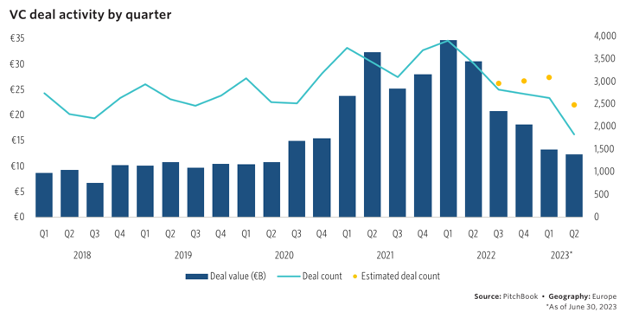
The fantastic and also harrowing backdrop to consider is economic distress, climate change, war in Europe, the US and China’s decoupling, unrest in the Middle East, and investment activity falling (see image); all while the FAANG(-N)s jostle for AI supremacy.
At the same time, Governments are taking a position on AI as the tech itself matures into economic realities.
This next wave of innovation will be driven by generative artificial intelligence or GenAI, delivered across 3 tiers: the Picks and Shovels (think Nvidia making the hardware); platform plays (such as ChatGPT delivering the software); and then the ensuing applications themselves being applied into business.
Selfishly, I want more of it all, full stack, in the UK and across Europe. We have the talent, and capital, but lack the infrastructure and joined-up thinking around regulation and support… If only there were a way of unifying Europe. Hmm… That said, to many pundits, the EU is not the place to be because of how restrictive and burdensome EU regulation is compared to the US or China.
AI will be persuasive and pervasive.
Personally, I believe AI will shine through and make waves, but, either way, in VC, it doesn’t much matter: startups will follow the money and markets. It’s just a shame that the wider benefits are lost to our local ecosystem when financial rewards (and talent) head offshore.
France doesn’t care what Europe is or thinks, and it is going for it, brilliantly playing what I think of as “The BIG Draw”. Aggressively and publicly investing in AI, Macron launched a €500m AI fund in June, shouting from the top of the Eiffel Tower. Then, it was Mistral later that month, raising $113m after only a few weeks of existence. And, most recently, Poolside: a US AI startup that moved its HQ from the US to Paris.
A US firm moving to France? Vive l’AI!
There are some AI noises in the UK, but nothing to blow your hair back. Rishi is obviously thinking about it. There’s the Mansion House Compact, encouraging our pensions into VC/PE; and we have the AI safety and alignment crew now camping out in Bletchley Park. But it’s not enough. We must do more as a United Kingdom: think bigger; be bolder. Again, we have the capital and more than enough talent.
Speaking of talent, one interesting aspect of this AI transformation is that it’s mostly white-collar. Information workers will be most disrupted, which is a first.
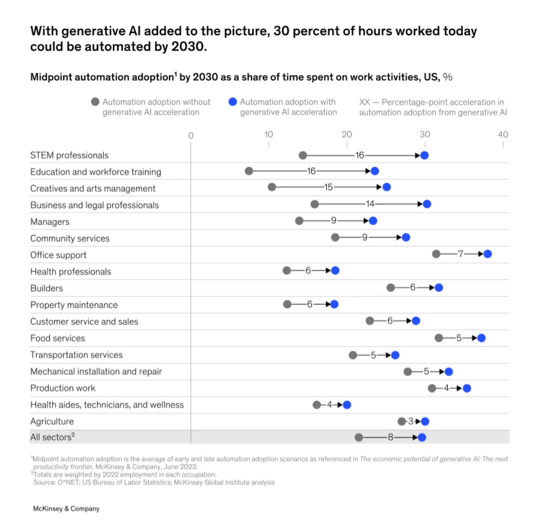
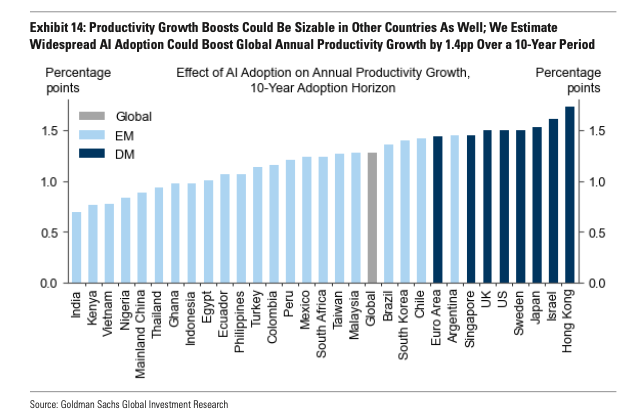
A recent Goldman Sachs report suggests the boost to global labour productivity could increase annual global GDP by 7% due to AI.
To put in context that’s about $7trn in 2023 money.
With this in mind, AI, which has been around for decades, has recently seen a significant increase in mentions on Russell 3000 earnings calls.
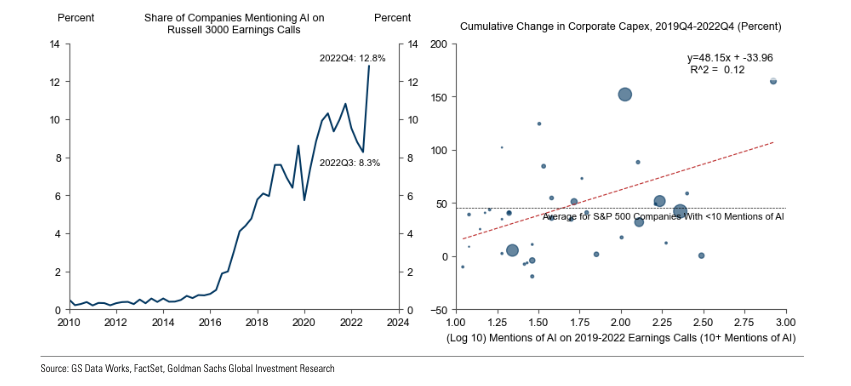
AI mentions on Russell 3000 earnings
Management teams are focusing on AI because, for the first time, the output is indistinguishable from a human. The promise has arrived, or at least a version of it. Not all AI is created equally, and not all applications are as impressive, but we are beyond the usefulness threshold for many use cases. In some instances, beyond human application *and* ‘intelligence’ baseline. If you look at the O*NET and ESCO databases of ~2000 US and European occupations, it’s possible to consider the breakdown of which roles will be most affected, and by how much.
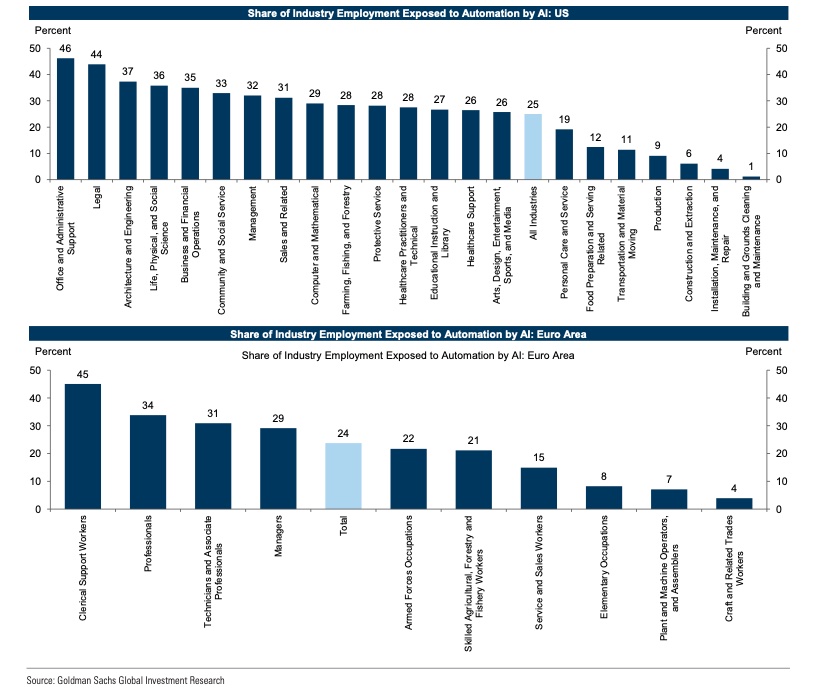
25% of tasks will be automated with 18% of all work fully automated by AI
Most jobs will be disrupted, many ‘augmented’ while some will be completely replaced (it’s probably a terrible time to get into radiography). The way I view it, information workers will be given superpowers. Management teams 10x’d, as well as engineering, sales, legal, healthcare, and many, many more.
All of this is only applying the technical approaches we currently understand. The AI race has only just begun, you can argue we’re only 10 months into this latest run, so it’s all hard to predict, and who knows what amplifiers will be added on top over time – It won’t just be AI. We’re at the beginning of a hype cycle that will break all the rules. I will confidently state that we have never seen such a transformation, which will reach far beyond business and economics.
Countries most affected will be those drowning in knowledge workers. If you look at saturated financial hubs such as Hong Kong, they will fare the worst or best depending on which side of the desk you’re sitting.
Big tech is all in, and the engine is running. Zuck recently sacked his Metaverse team and has fully pivoted to AI. And if you look at Alphabet’s income stream, it is all AI or defined by it:
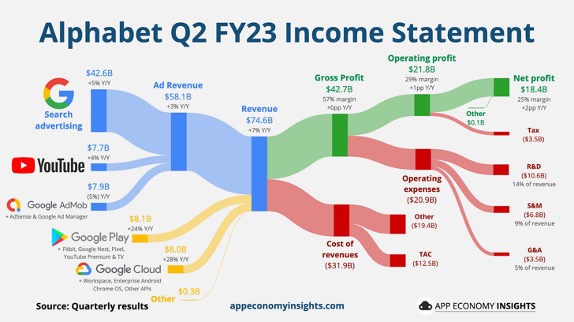
Sundar Pichai, Alphabet’s CEO stated:
“AI is the most profound technology humanity is working on. More profound than fire, electricity, or anything that we have done in the past.”
Looking at last week’s mega funding rounds, most were in health tech, AI and fintech. Although there’s a falsehood inherent in that statement:
All companies are, or soon will be, AI companies.