



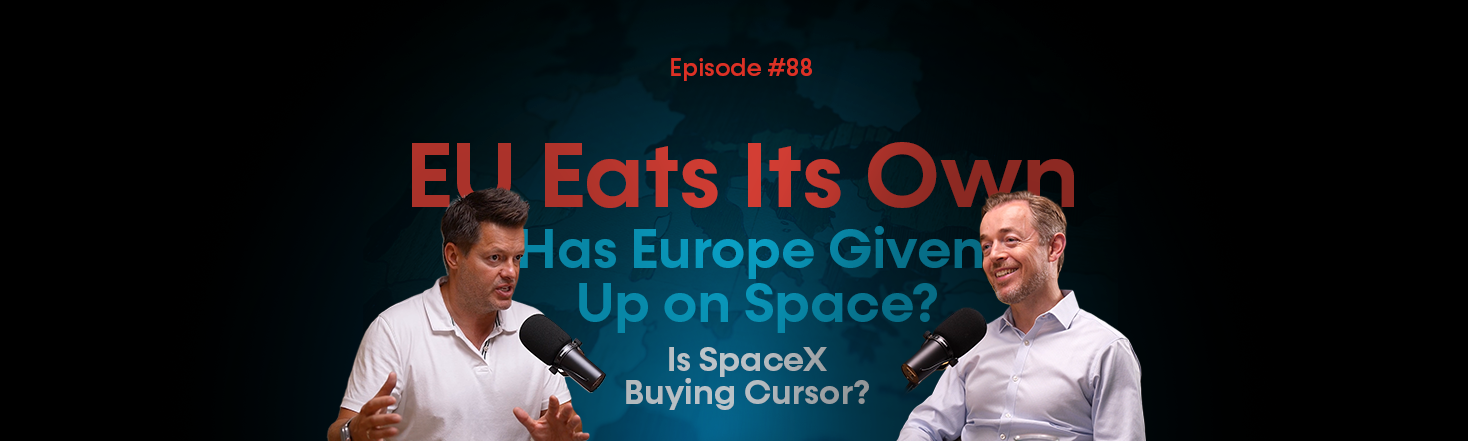
DeepSeek V4 dropped overnight at Opus 4.6 level, trained entirely on Huawei chips. 78 days of frontier lead for the US labs. Brussels is quietly gutting its own AI Act, SpaceX has optioned Cursor at 60 billion dollars, and Europe has ceded space sovereignty to Starlink until 2029.
- DeepSeek V4 benchmarks at Opus 4.6 level, shipped 78 days behind, trained without a single Nvidia chip. The compute moat is not what it was.
- The EU AI Act is being rewritten on 28 April. Dressed up as simplification, closer to a quiet repeal.
- UK Biobank did not have a breach. France's ANTS did. 19 million records, run by Atos, which is insolvent.
- SpaceX optioned Cursor at 60 billion dollars, 10 billion dollar break fee in Colossus compute. xAI just bought its distribution layer.
- IRIS² is architecturally right and politically wrong. 290 satellites will not match Starlink's 7,000.
- Credit default swaps on Blackstone, Apollo and Ares now exist. UBS has 25-35% of the private credit book as AI-disruption-exposed.
Upside is a weekly podcast designed to look behind the headlines that will affect European venture, startups and investing.
Below are the notes from this week’s episode. Episode links above to tune in and stream wherever you pod.
DeepSeek V4 and the 78-day gap
V4 is open weights, free to the world, in-house benchmarks at Opus 4.6. Anthropic shipped Opus 4.6 on 5 February. 78 days of frontier lead on a Chinese open source model.
Trained entirely on Huawei chips. DeepSeek rewrote the stack from CUDA to Huawei’s CAN. The compute moat Washington has been betting on for three years has a new bridge across it, and Google’s TPU 8 ships this week. Anthropic has formally alleged industrial-scale distillation, which is why enterprises will be slow to send proprietary code to Chinese-hosted inference. But V4 is open source. Pull it from Hugging Face. AWS will host it. Run it at a twentieth of the cost of Opus.
Frontier labs have to become application companies. Distribution is the moat, not weights. Our shot has never been in frontier compute. It has always been in apps.
The EU AI Act gets quietly buried
Tuesday 28 April, second trilogue. High-risk standalone systems slip to December 2027. AI in regulated products slips to 2 August 2028. The whole high-risk category is being folded into other safety laws. Close to a repeal.
Mads put it plainly. Making it super hard for our own companies to compete was never going to protect European AI. Brussels is admitting the mistake and calling it simplification. Fine. Cleaning up a mistake is not a strategy. You still need an inference chip plan, public procurement as anchor demand, a 28th regime, European pension capital into innovation, and a decision on how we power the data centres. Nuclear, SMRs, both. Pick one.
The breach that wasn’t, and the breach that was
ANTS is the real one. 19 million French driving licences, ID cards and passports on the dark web. Run by Atos, insolvent. Capita did a version in 2023 with 6.6 million records. Government outsources sensitive data, contractor fails. Procurement story, not cyber story.
Biobank is different. 500,000 UK volunteers, open-access by design since 2003. Someone downloaded it and put it on Alibaba. De-identified but not anonymised, so re-identifiable. A 2003 policy colliding with 2026 capability. Pair both with the ID card debate. Estonia has run distributed digital identity since the early 2000s: data in individual agencies, audit trail on your phone, selective disclosure by default. The UK answer is 27 separate systems. That is 27 more attack surfaces. Digital ID is not optional for a modern economy. The question is architecture, not ideology.
Brin, SpaceX, Cursor
Sergey Brin is back at DeepMind leading a coding strike team. Gemini engineers are now required to use the internal agents rather than Claude Code, which they had reportedly been using. A bit embarrassing. Meanwhile Google owns 14% of Anthropic and just inked a 10 billion dollar TPU deal with them. The PR story and the cap table do not agree.
SpaceX optioned Cursor at 60 billion dollars on Tuesday. Option, not cash, with a 10 billion dollar break fee paid mostly in Colossus compute. The deal pre-empted a 2 billion dollar Series D hours from closing at 50 billion pre-money. Cursor is 2 billion ARR, 67% of the Fortune 500, over a million daily developers. OpenAI has Codex, Anthropic has Claude Code, xAI had nothing. Cursor is xAI’s front door. For Europe, Lovable is the equivalent bet. Front end is interesting. Enterprise coding and physical AI (robotics, factories, vehicles) is more interesting.
Europe cedes space to Starlink
Starlink has 7,000 LEO satellites. Europe has around 600. Italy is in talks for a 1.5 billion euro Starlink deal. When Ariane 6 was late last year, Falcon 9 put Galileo satellites into orbit.
IRIS², the 10.6 billion euro sovereign answer, does not launch until 2029, full operational capacity 2030-2031. Architecture is correct. Procurement is not. Geographical return, pork-barrel allocation by member state, is holding the programme back. Scrap it. Let a thousand flowers bloom across launch, manufacturing and ground control. Pick the winners. Good news: French startup Univiti raised 27 million euros yesterday to build sovereign space connectivity for European telcos. Small number. Right direction.
Credit default swaps on private credit
JP Morgan, Barclays, Morgan Stanley and Citi are now making markets in CDS on Blackstone, Apollo and Ares. A month ago this market did not exist. Roughly 20% of BDC loans went to software during ZIRP. UBS puts 25-35% of the private credit book on AI-disruption-exposed cash flows. Blackstone took 3.8 billion of redemption requests in Q1 and posted its first monthly loss in three years. Apollo paid 45 cents on the dollar.
Not 2008. Leverage is lower, exposure is nothing like subprime. But if US SaaS comps rerate 30% and BDC-financed roll-up exits slow, European portfolios benchmarked on US SaaS feel it. If you are a pre-AI SaaS business, your multiples compress. Build moats. Integrate with hardware. Get proprietary data. Go AI-native in the organisation, not just the product. The moat still matters. What counts as a moat has changed.
Predictions and deals
Two predictions. One: the next trillion dollar European company will be a defence prime, not a software company. Mads pushed back, Helsing is a software company. Fair. The categories will merge. The money and the sovereignty sit on the defence side. Two: Anthropic crosses 100 billion dollars in revenue and never IPOs. On trajectory for 100 billion this year. Never IPO is the spicier half.
Mads’ deal: Atmos Space Cargo (Germany-France), 25 million euros Series A, brings cargo back from space. Americans can. Russians can. Europe could not, until now. My deal (a week late): European Defence Fund, 1 billion euros across 57 projects, 37% year-on-year bump in proposals. Mostly grants. Bedrock for procurement to build on.
Notable Quotes
“The advance that Frontier Labs in the US have on Chinese open source models right now is 78 days.” – Mads Jensen
“If you want a modern economy, a digital ID is not optional. You can’t have a digital economy if government can’t verify who you are.” – Mads Jensen
“Business is still built in the good old way of creating moats. It’s just that what constitutes a moat has changed.” – Mads Jensen
“Software is no longer a separate industry. Software is eating the world and just better than everything.” – Mads Jensen
Frequently Asked Questions
How close is DeepSeek V4 to Anthropic's Opus 4.6?
On DeepSeek's in-house evals, V4 benchmarks at Opus 4.6 level. Opus 4.6 shipped on 5 February 2026, putting the frontier gap between US labs and the leading Chinese open source model at roughly 78 days.
Was DeepSeek V4 trained on Nvidia chips?
No. V4 was trained entirely on Huawei chips after DeepSeek rewrote the stack from Nvidia's CUDA to Huawei's CAN. A direct challenge to the compute moat thesis behind three years of US semiconductor export controls.
What is changing in the EU AI Act on 28 April 2026?
The second trilogue is expected to slip high-risk standalone AI to December 2027 and AI in regulated products to 2 August 2028. The high-risk category is also being folded into other safety laws, which many read as closer to a repeal than a simplification.
What did SpaceX agree with Cursor?
An option to acquire Cursor at 60 billion dollars later this year, with a 10 billion dollar break fee paid mostly in Colossus compute access. The deal pre-empted a 2 billion dollar Series D at 50 billion pre-money. Cursor serves 67% of the Fortune 500.
Why is Europe falling behind in space?
Starlink has around 7,000 LEO satellites, Europe around 600. IRIS² does not reach full operational capacity until 2030-2031. Geographical return rules slow delivery, and 290 satellites is insufficient service quality against Starlink.
Are credit default swaps on private credit a 2008 signal?
No. UBS estimates 25-35% of the private credit book is AI-disruption exposed. Instruments and leverage are nothing like subprime. But European venture portfolios benchmarked on US SaaS comps should mark forecasts down.