


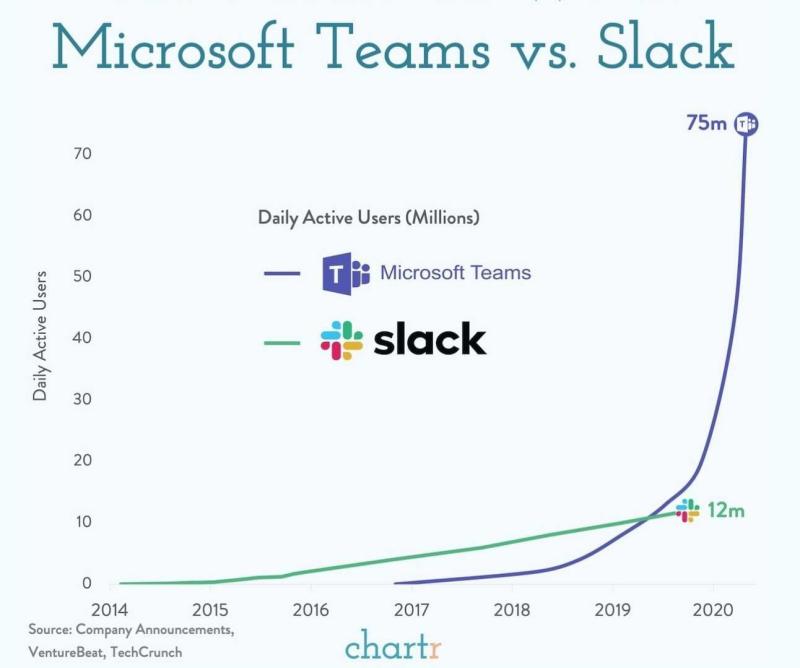
Using the story of Slack and Microsoft Teams, Mads Jensen argues that in enterprise SaaS a great product is table stakes but superior distribution often wins, so B2B SaaS companies need to be both product-led and sales-led.
- Product-led growth relies on beautiful software, easy adoption and users who drive expansion, and is likely the only option when selling to small businesses.
- The author's company Sefaira adopted Slack overnight because it was easy to set up, spread organically and charged only for what was used.
- Microsoft launched Teams in 2016 and, within six years, had six times more users than Slack, helped by its relationships with CIOs of Fortune 500 companies.
- Slack remained the better product in the author's view but was acquired by Salesforce rather than becoming the dominant force many expected.
- The conclusion is a pincer movement: build a great product and a strong sales playbook to reach big customers.
The best product always wins.
Or does it?
Product-led growth is all the rage:
- Develop beautiful software,
- make it easy to adopt, and
- empower users to become champions that drive expansion.
It’s a beautiful vision. And if you sell to small businesses, it is likely your only option. But should SaaS companies that target the enterprise be product or sales-led?
Meeting Slack
I remember the first time I saw Slack. What a beauty. It was back when I was building Sefaira (B2B SaaS company selling to architects and engineers). We’d been struggling with internal instant messaging for a while. Various teams had created their own chat channels in Skype. It was not a great collaboration experience. We needed something new.
One day our developers came across this new instant messaging platform that epitomized the beauty of SaaS. With Slack, there is nothing to install. Setup is a breeze. Organic deployment. Viral adoption. Only pay for what you use. In some ways, perhaps one of the first true fulfillments of Salesforce founder Marc Benioffs vision for SaaS. Just so easy and beautiful.
We adopted it overnight and never looked back.
Microsoft Arrives
A few years later (2016), Microsoft decided to join the fray with MS Teams. And bearing in mind the clunkiness of many MS products, it was hard to see how they could beat Slack. In fact, Legendary Slack Founder/CEO Stewart Butterfield went “all-out” hubris mode. He took out a full-page ad in the New York Times to welcome Microsoft to the era of modern collaboration software.
The letter included lots of “friendly advice” for Microsoft. But the subtext was not so subtle. The dinosaurs of Seattle and their archaic software would be no match for the pioneers of product-led growth.
Except they would. Because it turns out that it’s great to have a superb product. But in enterprise, it is more important to have relationships with the CIOs of Fortune 500 companies. And Microsoft had that in spades. Within six years, Microsoft Teams had six times more users than Slack.
The Aftermath
Today, Slack is still the better product. Founders and early investors did well. But Slack is no longer an independent company. Salesforce obliged with an exit and a new home for the business. And Slack never became the overpowering force many of us thought it could have become.
Because much as we all love beautiful products. In the end, superior distribution often wins.
That brings me back to the opening question. Should SaaS companies be product-led or sales-led?
In today’s world, the answer is both. It’s a pincer movement. Great products are table stakes (not that this makes them easy to build). But it takes great distribution to reach big customers. So get working on your sales playbook and call some prospects. And when you are in front of them, wow them with how quickly your beautiful product delivers ROI. That’s the way to win big in today’s market.
Frequently Asked Questions
Should an enterprise SaaS company be product-led or sales-led?
Both, according to the post. Great products are table stakes, but it takes great distribution to reach big customers, so founders should build a sales playbook and then show prospects how quickly the product delivers ROI.
Why did Microsoft Teams overtake Slack?
Mads Jensen attributes it to distribution. In enterprise, relationships with the CIOs of Fortune 500 companies mattered more than having the superior product, and Microsoft had those relationships in abundance.
When is product-led growth the right approach?
The post says that if you sell to small businesses, product-led growth is likely your only option.