



Dan Bowyer reviews AI's history, the explosion of interest after ChatGPT, its economic potential and the state of UK AI investment, arguing that AI is this generation's internet moment and that its biggest impact will come from combining it with other technologies.
- ChatGPT reached 100m users in two months, against four and a half years for Facebook.
- GitHub found developers completed tasks 55% faster with its AI Copilot, which completed 46% of their code in early research.
- PwC estimates AI could add up to $15.7 trillion to the global economy in 2030, and McKinsey estimates generative AI could add $2.6–4.4 trillion a year.
- According to Beauhurst, the UK has 1,486 AI companies that have raised £8.48bn across 3,283 rounds, making AI one of the UK's best-funded sectors.
- Dan Bowyer sees the biggest opportunity in 'AI+', meaning AI combined with technologies such as fusion or quantum computing.
AI is already, and will continue to be transformative at home and work. Few argue this point, but what’s *really* happening and what’s coming down the road? With the news cycle as it is, it’s often hard to truly decipher, so that’s what I’m going to have a pop at. Exploring what’s been built, applied, invested in, by whom, where and why.
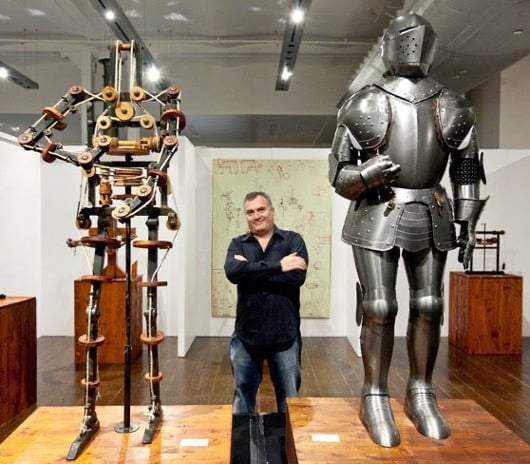
AI in useful forms been around for many years. It’s in Alexa, Siri, Google Search, FaceID and so much more, but our fascination with thinking and doing machines dates back to Plato with the concept of an automaton. Davinci’s notebooks are full of machina sketches, allegedly creating his robotic knight prototype in 1495 (a mock up shown in the pic).
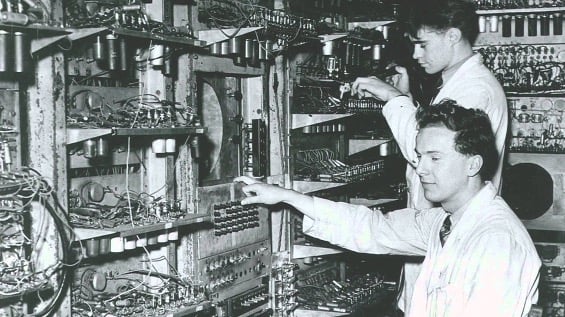
Our modern world view of AI was popularised by Alan Turing (building his Turing Machine computer) in the 1950s with his work on computer machinery and intelligence, crystallising with the Turing Test, but the term artificial intelligence was first used by computer scientist John McCarthy in 1955.
Between the 1950s and the 90s AI went on a bit of a rollercoaster from a boom in interest to an AI winter spanning the 80s and 90s where researchers globally seemed to run out of steam. So the money dried up and we therefore saw fewer breakthroughs – leading to an extended hype cycle trough until the noughties where it all got interesting again. With Deep Blue, speech recognition that actually worked, Mars rovers navigating without human intervention, IBM’s Watson won Jeopardy, and Apple launched Siri.
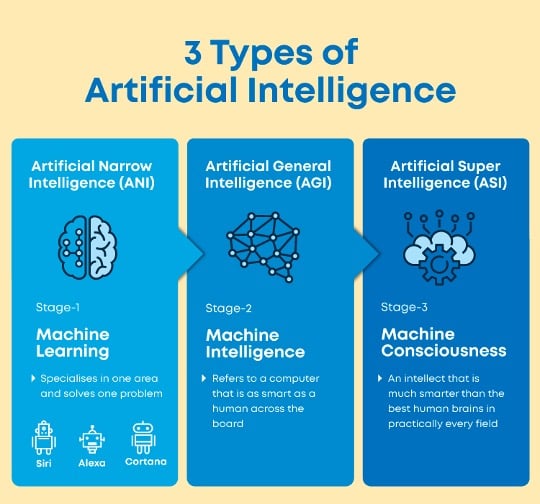
There are many ways to slice and dice the different types of AI but it’s probably most useful to think of AI in capability buckets –
1. Reactive (Deep Blue playing chess)
2. Limited Memory (Autonomous vehicles e.g. Tesla)
3. Theory of Mind (Human like – The hot topic of LLMs and potential sentience)
4. Self Aware (Super intelligent – the truly scary stuff, think I, Robot).
I think of AI as narrow (basic), general (human) or super (OMG) – so it depends what you read or who you speak to.
In Nov 2022 AI kicked again off with an unexpected game-changer. The stable release of ChatGPT unleashed the latest and strongest wave of interest in AI, with LLMs being discussed at many a middle England dinner party. It grew radically quickly, to most people’s surprise, hitting 100m users in 2 months. Compare that to Facebook, taking four and a half years.
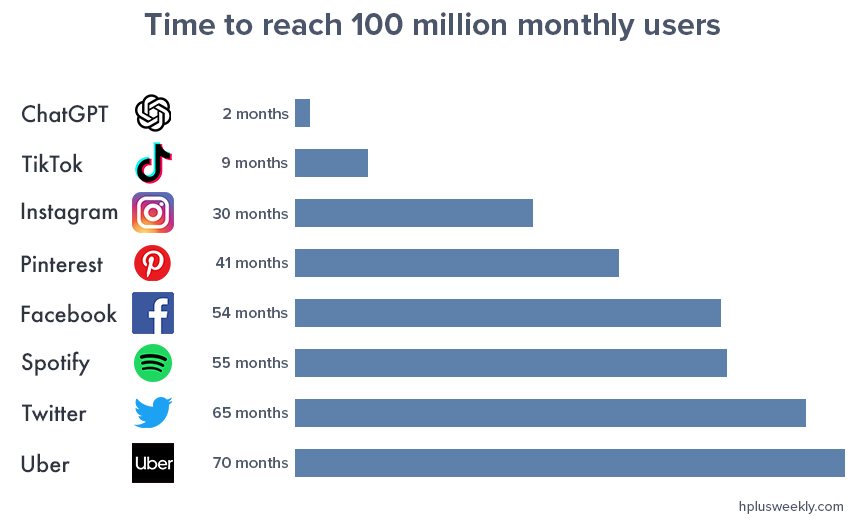
ChatGPT and other LLMs showed how AI could be relevant, useful, some going so far as to say sentient (not true) but it certainly is this generation’s internet moment.
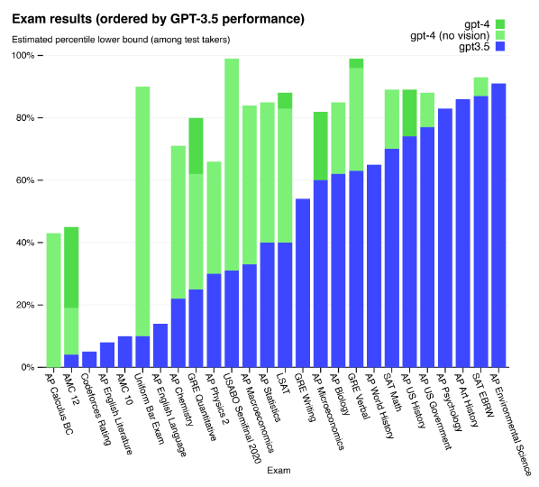
Want to pass an exam? Don’t ask Google.
Github found that software developers completed tasks 55% faster with their AI Copilot. Moreover, their early research found that 46% of code was completed by it. Most of the immediate tooling leaps using this style of GenAI will affect business operations, marketing and sales, software engineering, and R&D_._ And don’t get me started on Midjourney! I’m a little bit in love with how it creates visuals using AI (see the Stormtrooper). Text to video is not all that far behind – soon we’ll be typing simple text prompts to create our marketing promo videos. It’s just around the corner.

AI is big business.
Mads and I were devoted AI investors before it was cool and we rarely see a startup pitch deck without the term. Is it hype? Yes. But it’s also deeply meaningful and transformational, we just have to get through the next few years of noise. However, this definitely isn’t anything like the hype around crypto, web3, metaverse, etc. None of which ever had the mainstream potential.
All businesses will become AI businesses, whether they know it or not. Even Apple is moving on an accelerated timeline (allegedly Tim Cook has been heard saying they were asleep at the wheel), and you know it’s mainstream when Apple takes a seat at the table.
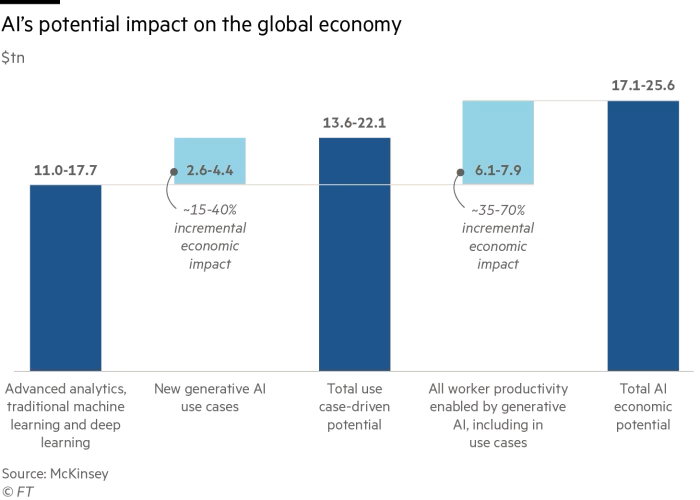
PWC reports that AI could contribute up to $15.7 trillion to the global economy in 2030, more than the current output of China and India combined. Of this, $6.6 trillion is likely to come from increased productivity and $9.1 trillion is likely to come from consumption side effects. McKinsey’s latest research estimates that generative AI specifically could add the equivalent of $2.6 – $4.4 trillion annually to global GDP – the United Kingdom’s entire GDP in 2021 was $3.1 trillion.
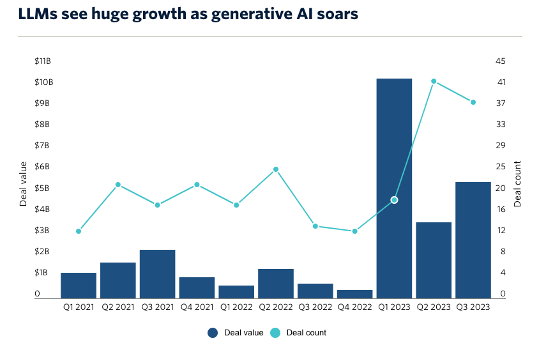
Businesses, startups and investors are fizzing about AI. Right now it’s GenAI and LLMs.
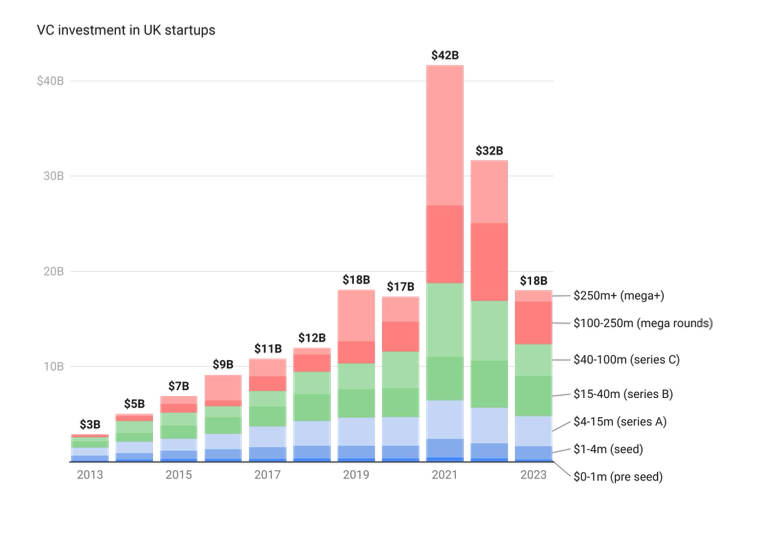
VC investment in the UK is starting to pick up. Looking at Dealroom data we’ve shaved off the crazy 21/22 excesses and are largely back to 2019 numbers. No bad thing to get back to good ‘fundamentals’ business.
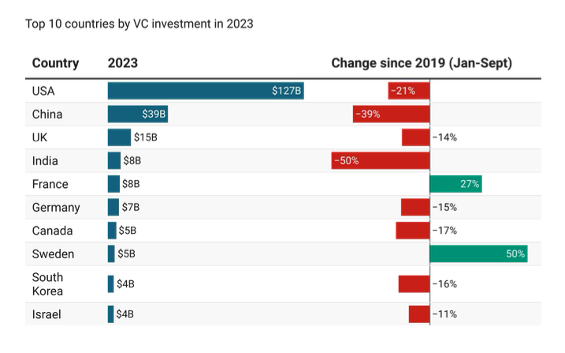
The UK leads Europe for VC investments by 200% and this is where we fit in globally. USA is still 10x, so there’s a long to go but we are definitely on the map. Personally I’m hoping we go for it commercially, take this disrupted moment to leapfrog and not to just focus on alignment and safety which feels like the current UK drive for airtime.
It’s hard to break down exactly what levels of capital are going directly into AI because what *is* an AI business? It’s easy to pinpoint AI pick & shovel businesses such as NVIDIA, or AI platforms such as ChatGPT but what about the applications across deeptech, biotech or climatetech as examples. We know *all* will be applying AI but won’t necessarily be labelled as such.
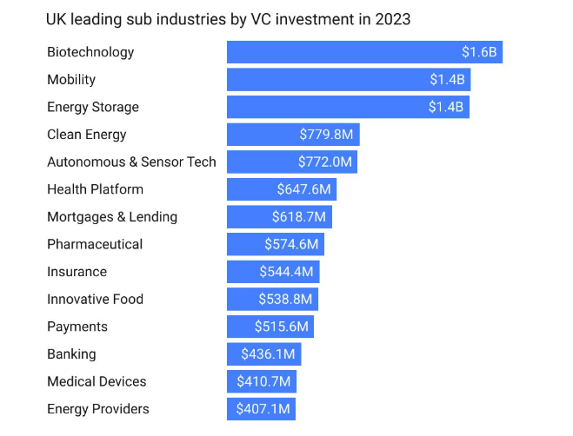
We do know that the UK is leading Europe as a popular place for artificial intelligence companies to set up. According to Beauhurst there are currently 1,486 AI companies across the UK, out of earliest startup and in growth mode. Collectively, these businesses have secured £8.48b worth of equity investment across 3,283 rounds, making AI one of the best-funded sectors in the UK. Not all countries are being served in the same way. For example ChatGPT isn’t available in: China, Russia, Ukraine, Afghanistan, Iran, Belarus or Venezuela.
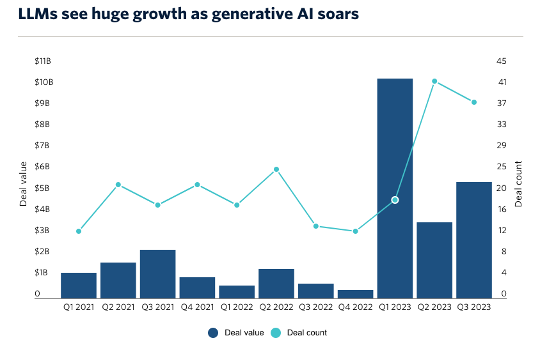
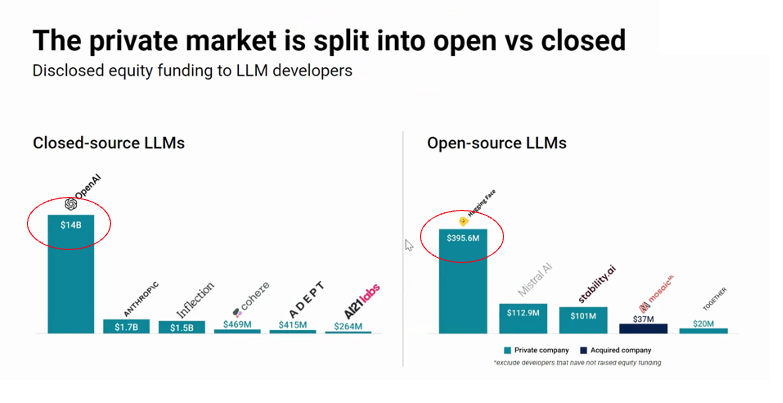
I could make a strong argument to say that AI (specifically generative AI) has saved the investment world from itself, temporarily. If you removed AI from the investment activity charts they would tell a very different story. The loud and proud investments into OpenAI, Anthropic or Mistral are keeping things buoyant. All coming at a time when the world needs it most. Technology is efficiency and AI is efficiency on steroids, vitamins and curly kale combined. This chart shows how valuations split across Closed (mega) vs Open Source (moderate) AI – another hotly debated topic. Which is best. An exploration for another time.
So what’s the outcome of AI? What will it all mean?
Aside from the predictions above, In simple terms it’s 10x time. Productivity up. Efficiency up. Yes labour markets will be disrupted but not like most people think, and it won’t be overnight.
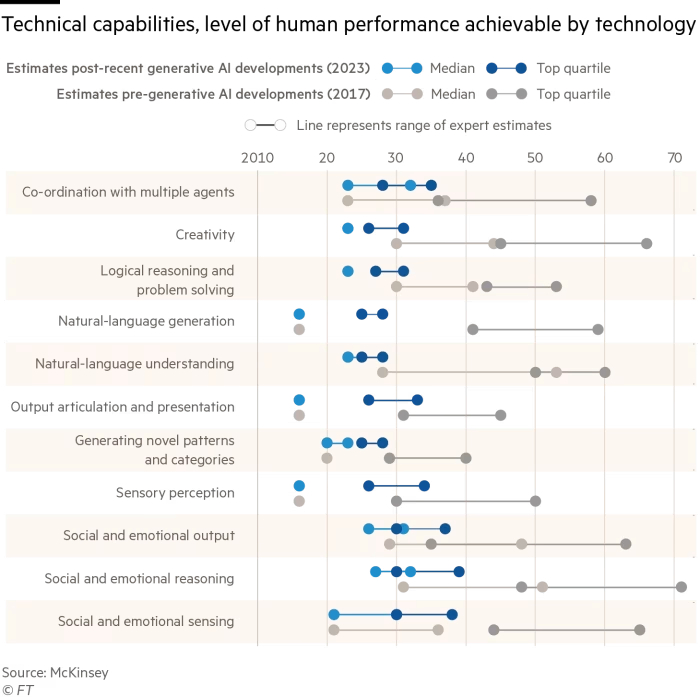
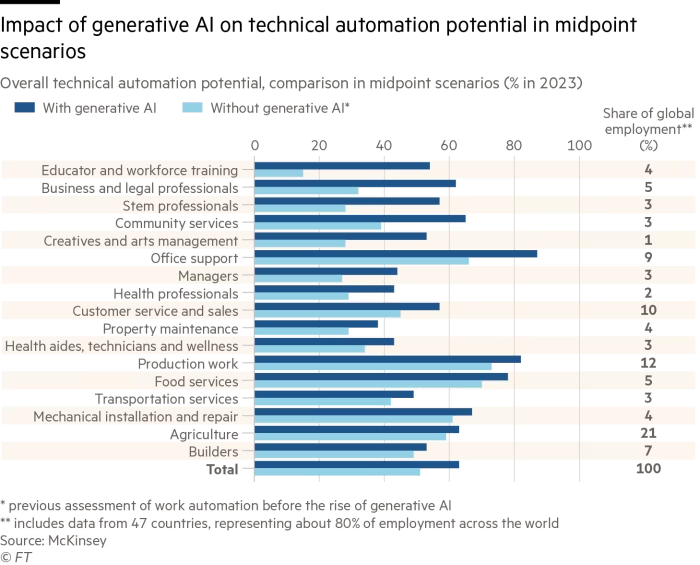
If you look at how some sectors naturally resist – legaltech for example, it’ll just take time to get to a threshold of disruption. In other sectors there will be union kickback, regulatory challenges or other govt interventions – mostly understandable. Not all sectors are created equal, or will be contorted in the same way.
But AI is coming.
I dare say however heavy handed the new EU AI regulations are, or whatever the executables in Biden’s executive order – AI will find a way. Hopefully we’ll never have to ask ourselves – “who is the bad actor here?”.

But on the positive foot, for the first time it’ll be a white collar revolution. Where the technology itself will also be able to deliver solutions to the very problems it poses, especially around safety and alignment. This will be the first time that a technology can fix itself. We just have to ensure the weakest link in the chain does the right thing at the right time.
What excites me the most is not how far AI will go beyond GenAI (we have a LONG way to go) but what happens when it’s compounded by other technologies coming down the track. Again, many will be transformational for society:
How we create energy, work, manufacture, run supply chains, predict weather, educate, create vaccines, cure cancer, fix climate and so much more.
So for me it’s a case of AI+.
For example AI+fusion (energy), or AI+quantum (computational unlock), or AI+thenexttransformative technology. It’s just a terribly exciting time to be alive as a VC or anywhere in the world of innovation. Yes we need to show care, love, attention but technology will save us.
It always has.
Frequently Asked Questions
What are the main types of AI?
The post groups AI into four capability buckets: reactive (like Deep Blue playing chess), limited memory (like autonomous vehicles), theory of mind (human-like, the debate around LLMs) and self-aware (super-intelligent). Dan Bowyer simplifies this to narrow, general and super AI.
Is AI just another hype cycle like crypto or the metaverse?
Dan Bowyer accepts there is hype, but argues AI is deeply meaningful and transformational, unlike crypto, web3 or the metaverse, which never had mainstream potential. He expects all businesses to become AI businesses.
How will AI affect jobs?
He expects productivity and efficiency to rise and labour markets to be disrupted, but not overnight and not in the way most people think. Some sectors, such as legal, will resist for longer, and for the first time it will be a white-collar revolution.